
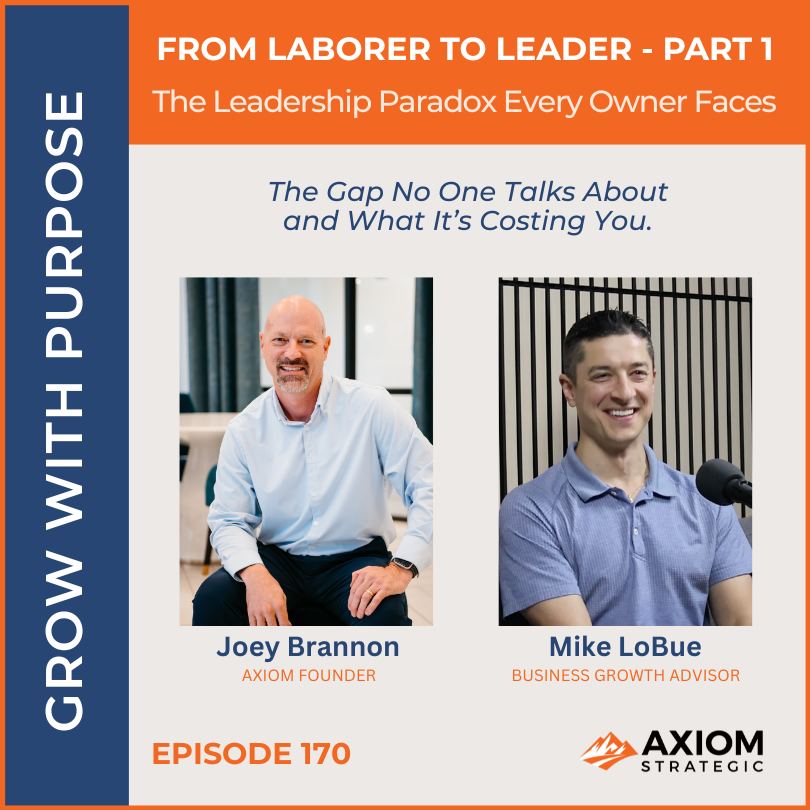
170: From Laborer to Leader - Part 1: Why the Gap Exists (and What It’s Costing You)
The Leadership Paradox Every Business Owner Faces — and the Real Cost When Your Best Worker Becomes an Unequipped Manager
The Promotion That Feels Like Progress… Until It Isn’t
Every business owner eventually reaches the same critical moment.
You realize you need more leadership capacity. You look across your team and choose the person who has produced the most, delivered the most, and proven the most.
Your best laborer becomes your new leader. On paper, it feels like a smart move.
In reality, the transition from doing the work to leading the people who do the work is one of the most mishandled — and costly — shifts in small business growth. Not because the person lacks potential, but because they’re unequipped for an entirely different kind of work.
Early in the episode, I described what we call the laborer-to-leader paradox, something we see in both blue-collar and white-collar environments: “The thing that has made you most successful in your job… is the same thing that’s working against you when it comes to being a leader.”
These individuals have mastered a technical craft — often with thousands of hours of focused training — yet have received almost zero intentional investment in the soft skills, communication habits, accountability rhythms, and leadership skills their new role requires.
That gap becomes expensive — fast.
The Two Ineffective Leadership Defaults (and Why Neither Works)
When someone moves from the field or production floor into a leadership role, they typically default to one of two extremes. Both are natural. Both are understandable. And both are ineffective.
First, they try to stay “one of the guys.”
They want to keep things friendly. They don’t want to disrupt relationships built over years of working shoulder to shoulder.
Second, they swing to the opposite extreme and become overly authoritative.
A sudden hard line. A posture that says, “I’m in charge now.”
You don’t have to pick between being the friend or being the tyrant. Leadership is a completely different skill set.
This isn’t about finding the middle ground. It’s about learning to lead through a new lens — almost like moving from two-dimensional thinking to three-dimensional leadership.
Without training, people fall back on what they’ve seen modeled or what feels safe, even when neither approach actually works.
Why This Gap Exists in the First Place
Most companies promote from within because:
the person already knows the work
they’re trusted
they understand the culture
and it feels safer than hiring externally
But here’s the reality:
Technical excellence and leadership excellence require completely different toolkits.
As Mike explained on the podcast, referencing Alan Loy McGinnis’s Bringing Out the Best in People, the ratio of technical-to-people work flips dramatically as someone moves up:
Entry level: 80% technical / 20% people
Management: 50% technical / 50% people
Leadership: 20% technical / 80% people
So when owners pull their “best guy” or “best girl” out of the field, they unintentionally remove their most productive worker and place them into a role where the skills that made them successful no longer apply.
As Mike put it plainly: “All of a sudden, you're removing him… He's your most productive worker. And now he needs to lead.”
They don’t lack talent.
They lack preparation.
The Double-Impact Cost to the Business
When business owners promote their best laborer without a clear plan, they don’t just lose efficiency — they experience a painful double impact:
Production Declines
Your strongest field performer is no longer doing the work they mastered.
Leadership Stagnates
The new leader lacks the people-work tools needed to move the team forward, and performance stalls.
As I said in the episode: “I've lost the productive resource, and I haven't realized the benefit of the leadership resource.”
The Ripple Effect on Your Company
This breakdown rarely stays isolated to one role. Left unaddressed, it creates visible strain across the organization:
Decreased quality as standards slip
Damaged customer experience through inconsistency
Internal friction as morale erodes
When technical excellence is mistaken for leadership readiness, both the business and the individual lose.
The Cost to the Owner: Carrying More Than You Should
While the business impact shows up in KPIs, the personal toll on the owner is often heavier — and rarely discussed.
The personal burden shows up as:
persistent frustration
longer hours
stepping back into roles you thought you had outgrown
I joked about this on the podcast — but there’s real truth behind it: “We should probably be asking the business owner’s spouse what the cost is.”
The compensation trap happens when owners try to fix the issue by over-functioning:
answering questions others should handle
making decisions that belong to leaders
reclaiming tasks that should be off their plate
Instead of gaining capacity, the business actually loses it.
This is a problem of equipping — not effort.
The Cost to the Individual: A Silent Collapse of Confidence
This may be the most devastating cost of all.
Before the promotion, these individuals went home knowing they crushed the day. Afterward, many experience a painful shift:
internalized failure
constant self-criticism
uncertainty about their value
One client shared that after a year without proper leadership structure, his top performer went from “feeling really good” every day to consistently thinking “that he sucks.”
That year is gone — for him and for his family.
This is why we treat leadership transitions as deeply human work, not just operational checklists.
What It Actually Feels Like for a New Leader
I shared on the podcast that whenever I jump into a brand-new skill — whether it’s complex research, technical software, or building a new program — it starts the same way: “You just feel lost… everything’s confusing. It’s this big ball of spaghetti.”
But then, with time: “There comes a tipping point where everything snaps into place.”
That’s exactly what new leaders experience.
They’re not failing — they’re adapting.
Most just need clarity, structure, and someone willing to guide them through the process.
Where Most Leadership Transitions Break Down
When we evaluate leadership pipelines with clients, we see the same pattern again and again:
Businesses put more planning into onboarding a new field technician than they do into onboarding a new leader.
That often means:
no job blueprint
no KPIs
no leadership onboarding plan
no 90-day structure
no documented expectations
no coaching or development
Without structure, people drift back to what they know — technical work — and avoid what they haven’t been taught — leadership work.
As Mike explained: “If people don’t have a job blueprint, they just do what they want to do… They’ll naturally do the things they’re good at and avoid the things they’re not good at.”
This isn’t laziness.
It’s human nature.
If you want different behavior, you must provide different guidance.
The Truth Business Owners Must See Clearly
Leadership isn’t a reward.
It isn’t a pat on the back.
It isn’t “the next logical step.”
Leadership is a development process.
Your people can become strong, trusted, capable leaders. They already have the work ethic. They already have the grit. They’ve already proven they can do hard things.
But they can’t manufacture leadership maturity on their own.
As Mike said: “They’ve already proven they’re willing to work hard… They just need guidance to develop this new skill set.”
Your investment in technical training got them here.
Your investment in leadership development will get them where you want to go next.
What’s Coming in Part 2 & Part 3
This series is designed to give you a practical roadmap rooted in real client conversations and the work we do every day inside growing companies.
Part 2 — The Mindset Shift Every New Leader Must Make
Helping people think like leaders before we expect them to act like leaders.Part 3 — The Skills and Systems That Turn Mindset Into Leadership
Translating leadership identity into daily habits, tools, and expectations that sustain growth.
Build Leaders Who Can Carry the Weight of Your Growth
If this episode hit close to home — if you recognized your team, your business, or even yourself — now is the time to act.
At Axiom, we don’t just help companies grow.
We help leaders grow — because the two are inseparable.
Take the next step:
👉 Download the Leadership Guide below — a practical tool you can use with your team today
👉 Share the podcast with your leadership team and start the conversation
Small businesses truly can change the world around them.
But that only happens when leaders grow on purpose.
If you’re ready to build leaders — not just promote them — we’d love to walk with you.
References and Downloadable Resources:
LinkedIn: Joey Brannon
LinkedIn: Mike LoBue
Episode 170: Leadership Guide