
173: The 7% Problem with Mitch Lomazov - Why Communication Breaks Down
When Context Is Missing, Conflict Follows — How Communication Protocols Strengthen Leadership Effectiveness
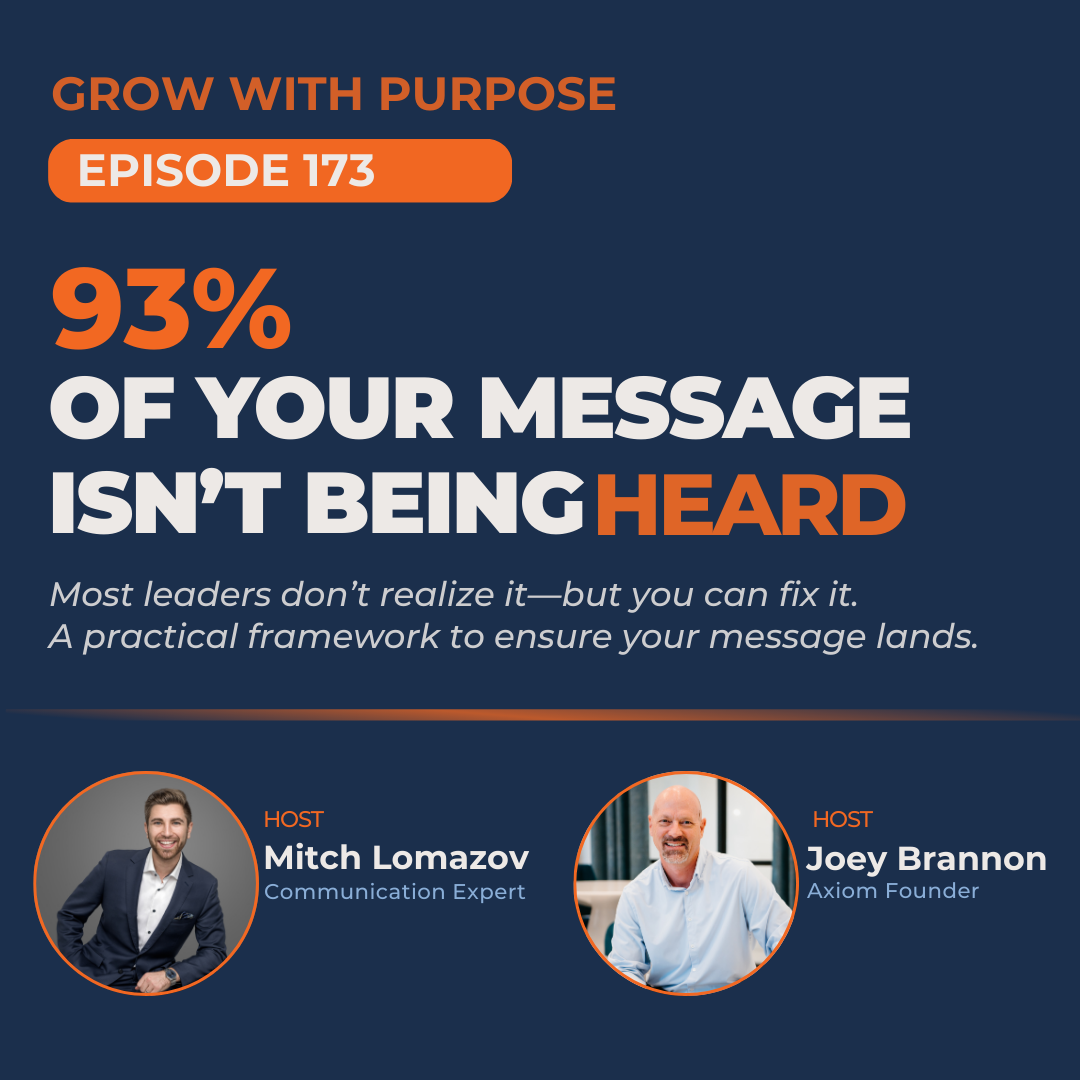
The Hidden Cost of Communication Breakdown
In nearly every culture survey we conduct at Axiom, communication shows up as the number one issue.
CEOs know it. Teams feel it.
But here’s what caught me off guard in my conversation with communication expert Mitch Lomazov:
When leaders rely on email for important conversations, much of the context required for understanding is removed.
The remaining meaning is often filled in by the receiver’s assumptions, past experiences, and emotional state.
That’s not just a communication problem. It’s a structural vulnerability that often leads to breakdown.
Key Takeaways for Leaders
Words alone carry only part of a message — tone, timing, and presence shape how meaning is received.
Email and text strip away context, forcing people to fill in gaps with assumptions.
Most communication breakdowns are systemic, not personal.
Clear communication protocols (matching the medium to the message) reduce unnecessary conflict and avoidable misalignment.
Strong leaders adapt how they communicate, build comfort with silence, and develop executive presence through technique.
Why Communication Feels Fuzzy (But Doesn’t Have to Be)
Most CEOs know communication could be better.
The real question is: What do I actually do about it?
Do I take a Toastmasters course?
Read another book on emotional intelligence?
Become a more empathetic listener?
Maybe all of the above would help.
But Mitch and I unpacked something more fundamental in this episode: communication isn’t a personality trait you either have or don’t have. It’s a system — and systems can be built.
That’s what this conversation is about.
The Breakdown: How Messages Actually Get Received
Mitch walks through a communication model that highlights how meaning is shaped by words, tone, and body language — not words alone.
The actual words — what is written or said
Tone and voice — how the message sounds
Body language — what is communicated visually
When tone and body language are removed, much of the context people rely on to interpret meaning disappears.
And here’s where communication begins to break down. As Mitch explains:
“If I communicate something with only 7% of the message coming across, and our brains require 100% of the data, then what happens is you fill in the rest.” — Mitch Lomazov
Translation: the same message can be interpreted very differently depending on the context the receiver brings to it.
The Protocol Solution: Match the Medium to the Message
So how do you fix it?
Mitch recommends establishing clear communication protocols in your organization — not theoretical ones, but protocols built from real experience.
Here’s the process:
Gather your team and identify recent conflicts
Work backward to see what communication method was used
Establish protocols based on real examples, not guesswork
The framework looks like this:
Text messaging: Check-ins, quick status updates
Email: Data-heavy information, follow-ups, reference materials
Phone calls: Conversations requiring emotional awareness, sales check-ins
In-person / Video: Performance reviews, critical feedback, conflict resolution
Mitch put it bluntly:
“Oftentimes, if I see in any organization, communication is an issue, and we unpack that… things were emailed when they should have been verbally communicated.” — Mitch Lomazov
The Person on the Other End Matters
But protocols alone aren’t enough.
You also need to understand who you’re communicating with, because different wiring requires different approaches.
Type-A Leaders (Go, Go, Go)
They want brevity. Don’t text back and forth for 30 minutes when a two-minute call would solve it. When they send short, direct messages, don’t take it personally — that’s often efficiency, not indifference.
Highly Relational Leaders
They need time. They want to hear about your personal life before diving into business. For them, that’s not wasted time — it’s how trust and engagement are built.
Detail-Oriented Leaders
They appreciate advance notice and thorough written information. Don’t catch them off guard in meetings. Send the agenda beforehand so they can prepare thoughtful responses.
The key insight: you’re not adapting out of obligation — you’re adapting because understanding how someone operates makes you more effective together.
As Mitch puts it: “Once they have that understanding of the way that other person operates and their wiring, they’re not doing it out of obligation anymore.” — Mitch Lomazov
Silence and Space: What High-Functioning Teams Do Differently
One of the most consistent patterns I’ve observed working with leadership teams: high-functioning teams aren’t afraid of silence.
Lower-functioning teams rush to fill every gap because silence feels uncomfortable. But strong teams create space for thinking.
In practice, that looks like this:
Thoughtful questions are followed by pauses
People are allowed time to process
The most vocal voice doesn’t dominate the room
I’ve seen this play out with CEOs and leadership teams repeatedly. The brilliant financial controller who needs a few seconds to think is often overshadowed when a sales manager rushes to fill the silence — costing the team insights that matter.
Mitch trains this intentionally. He once asked a highly introverted client a thoughtful question — then waited in complete silence for an entire minute before they responded.
His takeaway: “If you can get comfortable with two seconds of silence, you’re good.” — Mitch Lomazov
When leaders aren’t comfortable with pauses, they’re likely missing their team’s best thinking.
Executive Presence: It’s About Technique
Many CEOs have a compelling vision but struggle to communicate it.
They’re strong strategists. They’re deeply invested in where the business is going. But speaking at the all-hands meeting drains every ounce of energy.
Here’s what Mitch helped clarify: executive presence isn’t primarily about personality — it’s about technique.
Most leaders focus all their energy on what they’re going to say. But words are only 7% of the message.
The rest is how it’s delivered.
Step 1: Get the Words Right
Write out your message. Memorize it if needed. But recognize this only addresses a small portion of communication.
Step 2: Work on Your Voice
Audio-record yourself and listen for:
Speed variation
Inflection
Emphasis on key words
Intentional pauses
Step 3: Refine Body Language
Video-record yourself and watch for:
Chin position (slightly lifted)
Open chest and arms
Stable stance
One small adjustment creates a cascade effect. Lift your chin, and your voice changes. Your posture opens. Confidence follows.
As Mitch explains: “You change one thing with your body language, and all of a sudden, other things begin to fall into place.” — Mitch Lomazov
The Walking-the-Halls Reality
Not all communication happens from a podium.
CEOs also need to be effective in hallway conversations, warehouse walk-throughs, and impromptu office visits.
This is where many leaders unintentionally undermine their message.
I once sat in an office with a few team members when the owner walked in. The sentence started two steps before they entered, and finished two steps after they left.
We understood the message — but the delivery communicated urgency and distance.
Mitch’s advice is simple: “Give the space for your message. Don’t treat your message lightly.” — Mitch Lomazov
Stop. Get attention. Make eye contact. Then communicate.
Changing the Internal Script
Here’s a trap many leaders fall into: “I’m just not good at communicating.”
Mitch challenges that directly: “We need to delineate between not liking something and not being good at it.” — Mitch Lomazov
Most people don’t enjoy public speaking. That’s normal. But discomfort often gets translated into identity.
Mitch encourages leaders to reframe how they think before communicating: “I’m a phenomenal communicator, and this person can’t wait to hear what I have to say.” — Mitch Lomazov
And here’s the reality: “If you’re in any position of leadership, congratulations — it’s now a job responsibility.” — Mitch Lomazov
A Transformation Story
Mitch shared a story that captures what’s possible when communication is treated as a learnable skill.
One client was deeply uncomfortable speaking to strangers and highly concerned with others’ opinions. Through small, intentional exercises, confidence and awareness began to build.
Years later, that same client confidently addressed a room full of family and friends at his wedding — and today is recognized in his professional life for strong communication skills.
The transformation didn’t happen by accident. It happened through intentional practice.
What This Means for You
Communication isn’t a vague problem. It’s a system that can be improved deliberately.
Start here:
Establish communication protocols based on real conflicts
Know your audience and adapt accordingly
Build comfort with silence
Develop executive presence through technique
Show up fully when you communicate
Change the internal script you’re operating from
You’ve already proven you can grow a business.
Now it’s time to grow how you lead it.
Equip Your Team to Communicate With Clarity
Key Takeaways
This episode is an invitation to move from awareness to action — building communication systems that reduce friction and strengthen leadership effectiveness.
Download the Leadership Guide for Episode 173
Share this episode with your leadership team
Communication isn’t a luxury.
It’s the foundation of how you lead, how your team executes, and how your business grows.
References and Downloadable Resources
Website: Mitch Lomazov
LinkedIn: Mitch Lomazov
Episode 173: Leadership Guide
Turns communication into a repeatable system