
174: Building Client Relationships That Last
Why Trust, Consistency, and Communication Matter More Than Expertise
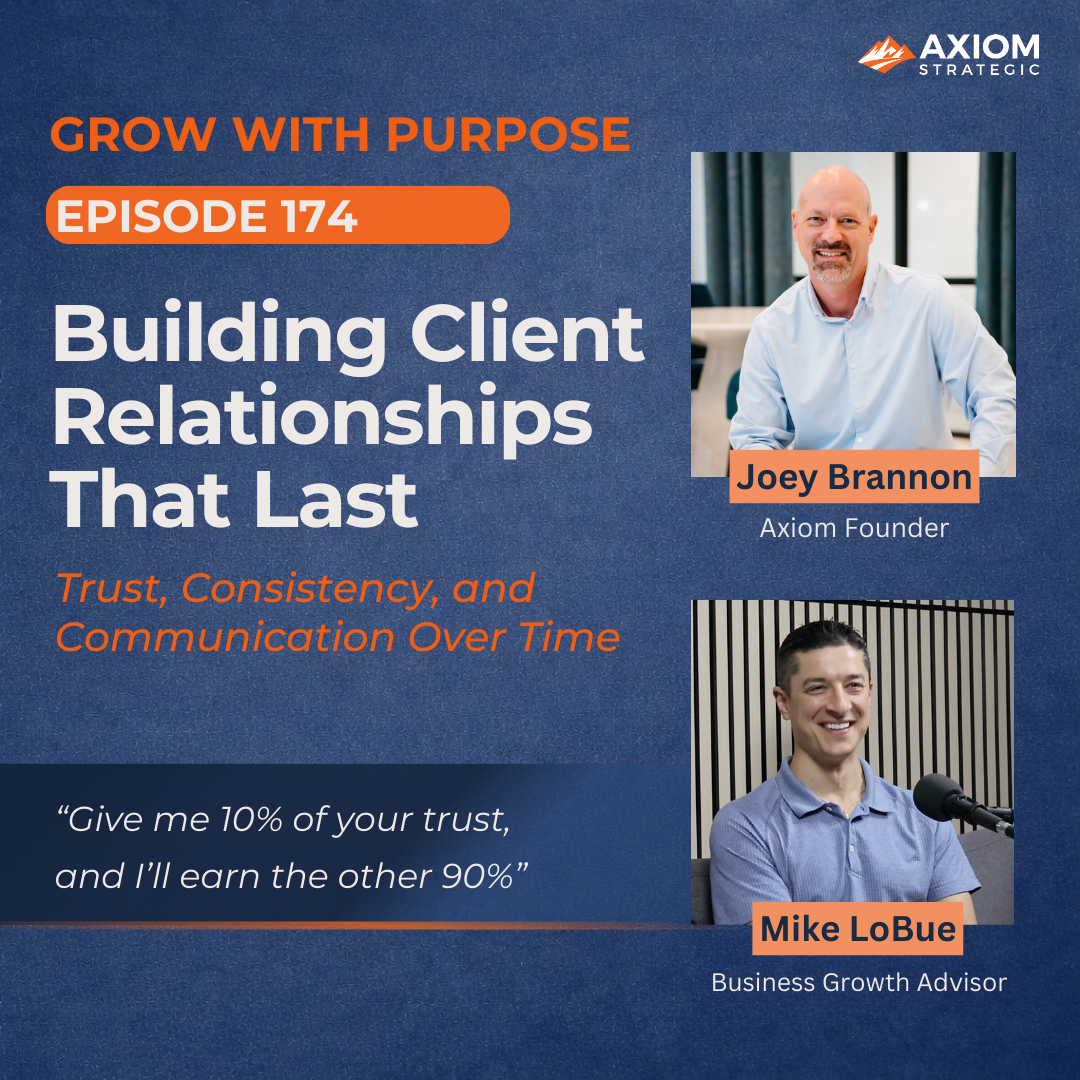
Building Client Relationships That Last
Why Trust, Consistency, And Communication Matter More Than Expertise
Most business owners don’t struggle because they lack technical expertise. More often, they struggle because the relationships that bring the real issues to the surface never fully form.
Joey and Mike explore what sustains long-term client relationships — why trust, consistency, and communication matter more than technical expertise, and how credibility is built slowly through follow-through over time.
Early in the conversation, Joey challenges the assumption that success is primarily about finding the right expert to solve a defined problem. Over time, Axiom has learned there are no clean dividing lines between technical answers and long-term leadership challenges. As Joey explains, there “really aren’t silos between the technical questions and answers that you need in your business, and then the longer-term things you may not even see over the horizon.” Those deeper issues tend to surface only when trust already exists—and when advisors have earned a seat at the table beyond the original problem that started the relationship.
What This Conversation Explores
This episode isn’t a checklist or a sales framework. It’s a reflection on what actually holds relationships together over time, including:
Why long-term relationships extend influence beyond the initial engagement.
How internal culture quietly shapes external trust.Why competence is the foundation—but not the differentiator.
How trust and credibility are built through consistency, not intensity.
Relationships Start Inside The Organization
Before discussing clients at all, Mike makes a critical observation: strong external relationships are built on strong internal ones. If leaders want their teams to build trust with clients, they have to model it first. As Mike explains, “if the relationships are strong within the company first… the advisors can go out and actually create the relationships.”
That internal consistency becomes the training ground for external trust. Without it, a “client-first” mindset remains theoretical rather than practiced.
The Tension Between Task And Relationship
Even leaders who value relationships wrestle with how they actually get built. Joey shares a recent lunch with someone he’d known for more than a decade who was exploring new career opportunities. He went in with a clear agenda—compensation range, experience fit, potential introductions.
But that wasn’t how the conversation unfolded.
An hour and a half later, they were still talking about family, college decisions, and life changes. Joey finally acknowledged, “at some point, we probably need to talk about what you’re looking over here for.”
Driving back to the office, he admitted something disarming: “as much as I talk about relationships, to be honest, I’m not very good at it, like my driver task orientation.”
The technical qualifications were already clear. What actually mattered was the time spent reconnecting on a deeper level. It was a reminder that agenda-driven interactions often miss what actually builds trust.
Letting Go of “It’s Just Business”
Joey reflects on an early belief that shaped his leadership—and why it eventually fell apart. He recalls telling clients, “it’s not personal, it’s only business,” and now looks back with clarity: “it is all personal.”
When businesses offer similar products, pricing, and delivery, the real differentiator is the people. Relationships aren’t a soft add-on to business—they’re what allow businesses to function when decisions get hard and stakes get high.
Long-Term Relationships Are Built On Competence And Time
Strong relationships don’t replace competence—they’re built on it. Early credibility comes from doing good work consistently. Over time, reputation grows, introductions happen, and opportunities expand.
Many of Axiom’s longest client relationships didn’t start quickly. One began with a lunch, a promising conversation, and a familiar response: “we definitely need this… but it’s not going to be immediate.” Joey followed up periodically, unsure if anything would come of it.
Two years later, the call came: “I’m ready. When can we start?”
That relationship has now lasted more than a decade—and over time, professional engagement turned into something deeper.
Joey shares about attending the funeral of a longtime client’s mother. It wasn’t expected. It wasn’t billable. It wasn’t work hours. It was simply the right thing to do. As he later explained to a young professional, “I count that as a great privilege of relationship, not of having somebody as a client.”
That distinction—relationship versus transaction—shapes everything about how Axiom approaches its work.
Once A Client, Always A Client
Some engagements take years to materialize. Others end when the work is complete or the fit changes. Yet the posture remains the same.
As Joey puts it, “once a client, always a client.” The work may change, but the relationship remains long-term. That means making introductions when Axiom isn’t the right fit, staying connected after engagements end, and trusting that outcomes follow relationships—not the other way around.
Trust Is Earned, Not Assumed
When it comes to trust, Mike frames it plainly: “give me 10% of your trust, and I’ll earn the other 90%.” Trust isn’t created through titles or expertise—it’s built through experience.
That experience is shaped by follow-through, especially when it’s inconvenient. Mike shares a moment where a deep, thinking-intensive client conversation that lost momentum because time ran out. Rather than waiting a week to pick it back up, he rearranged his schedule and met again the next day.
It wasn’t convenient—but it communicated something essential: the client mattered.
Consistency, not intensity, is what builds confidence.
Communication And Credibility Go Hand In Hand
Communication is almost always cited as a weakness in organizations, but the issue is rarely volume. It’s about rhythm. Predictable communication builds presence, and presence builds trust.
Mike observed this firsthand watching another Axiom advisor onboard a new client. Daily, simple communication—answers delivered, follow-through demonstrated—created confidence. There was no awkward reentry, no need to reset. The relationship stayed in motion.
Credibility grows the same way. Mike points to four elements that shape it over time: integrity, clear intent, proven capability, and consistent results. None can be rushed. All are demonstrated through behavior.
Credibility Requires Patience
As the conversation closes, Joey reflects on the long arc of trust. Credibility requires patience. It can’t be manufactured or shortcut. Track record matters—not just performance, but integrity, transparency, and follow-through sustained over years.
Looking back, Joey describes it as a “20-year, boring journey” of showing up, delivering, and doing the work. Over time, that consistency began to compound.
For leaders early in their journey, the focus must be on fundamentals. For leaders with decades behind them, the opportunity shifts toward growth—not just for revenue, but for influence. As Joey puts it, “if you have a history of being credible, the best thing you could do for the world is grow your reach and your influence.”
An Invitation To Act With Intention
Mike closes with a reminder: relationships don’t grow accidentally. They require intention.
Think about one relationship—a client, a team member, or someone in your personal life—that deserves attention right now. Encourage them. Re-engage. Repair what’s been left unresolved. Don’t leave relationships to chance.
If this conversation resonated, download the Leadership Guide to go deeper. You can also subscribe for future episodes and guides—and if someone came to mind while you were reading, consider sharing this episode with them.
References and Downloadable Resources
Stephen M.R. Covey - The Speed of Trust
Context: Credibility, trust-building, leadershipEpisode 174: Leadership Guide
Turns disciplines into tools