
181: Vision Alignment & Partnership Fit
Why Shared Vision, Expectations, and Motivations Determine Long-Term Partnership Success (ep. 3 of 4)
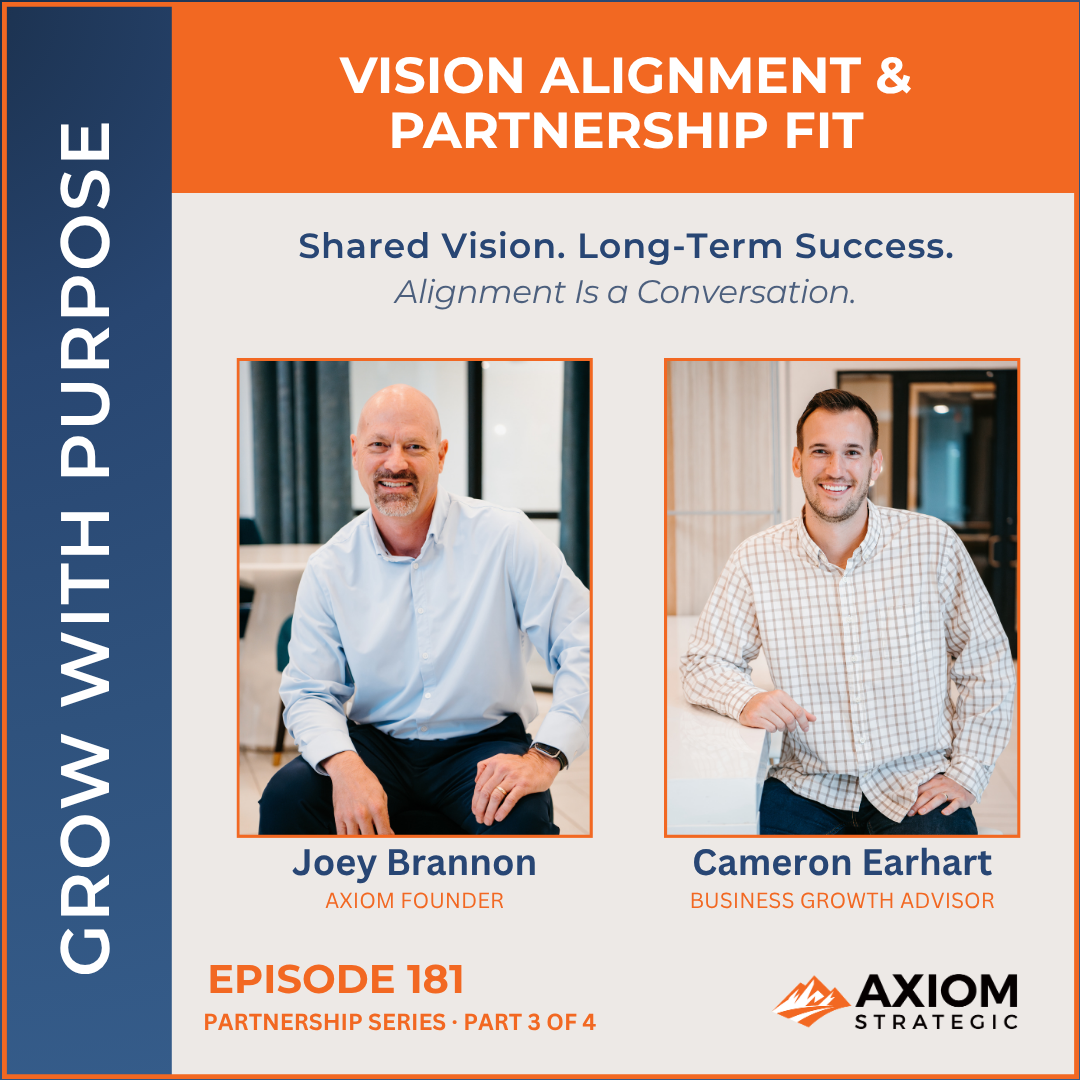
In the first two parts of this series, we covered structure and roles — operating agreements, decision authority, and the distinction between the owner hat and the employee hat.
Those are the mechanics.
This episode moves into something less visible but just as critical: whether you and your partner are actually pointed in the same direction — and what happens when you're not.
Where Partnerships Begin — and Where They Drift
Why early alignment doesn't guarantee long-term alignment
Most partnerships don't start with misalignment.
They start with momentum. Complementary skills. One partner handles sales, the other runs operations. In the early days, the focus is survival — can the business generate enough revenue to support both partners?
But the business grows. Leaders get hired. Operational responsibilities shift away from the owners. Both partners start stepping back from the day-to-day.
And that's when the real question surfaces:
Where are we actually going — and are we going there together?
The Assumptions That Quietly Create Conflict
Unspoken expectations shape the direction of the business
One of the most consistent patterns we see at Axiom is partners assuming alignment without ever actually confirming it.
It sounds like:
"Of course we're reinvesting profits back into the business."
"Of course we're building this to sell eventually."
"Of course we're passing this down."
There is no "of course." There are only assumptions.
And assumptions don't surface early. They surface the first time a real decision forces them into the open.
Capital allocation is usually where it shows up first. One partner wants to reinvest aggressively — hire people, expand capacity, build infrastructure. The other believes the business should be generating consistent income through distributions. Neither perspective is wrong. But if those expectations were never defined, tension is inevitable.
The same fault lines run through growth strategy, exit planning, and how the business handles profit. These aren't operational decisions. They're directional ones. And most partners have never sat down and compared notes on them.
Motivation Matters More Than Most People Realize
Why partners need to understand each other's "why"
At the root of most partnership drift is something deeper than strategy: different underlying motivations.
For some, the goal is financial — build wealth, create optionality.
For others, it's legacy — build something that lasts beyond them.
Others are driven by lifestyle — control over time and flexibility.
And for some, the business is a platform to serve others and create impact beyond profit.
None of those motivations are wrong. But they are not the same. And if they're not understood, they eventually collide.
We talked about this in the context of faith-driven businesses — two partners, both strong in their faith, where one believes the primary function of profit is to fund ministry and charitable giving, and the other wants to build family wealth and make those charitable decisions personally. Both are operating from deeply held values. That's exactly what makes it hard to navigate without help.
Alignment Doesn't Mean Agreement
Different perspectives can strengthen a partnership — if they're not in conflict
You don't have to think exactly the same way as your partner. But your perspectives can't be in permanent competition.
Cameron put it directly: "Different perspectives don't break partnerships. Unresolved conflict does."
One partner who pushes for growth and one who's more conservative on risk can be a great combination — if both understand what the other is doing and why. The question isn't whether you're identical. It's whether your differences work together or work against each other when a real decision lands on the table.
Vision Alignment Isn't One and Done
It must be revisited as the business and its people evolve
Even if you were fully aligned at the beginning, that alignment doesn't hold on its own.
People change. Priorities shift. The partner who wanted to build aggressively for twenty years starts thinking about an exit. The one who was fine reinvesting everything starts thinking about what he wants to leave behind.
That's not failure. That's reality. Cameron said it plainly: "It's not one and done."
I think about it like healthy marriages. My wife Josie and I have a regular check-in — one of the questions is simply: share a wish, hope, or dream. Not an agenda. Just a low-stakes conversation that keeps two people from quietly drifting apart.
The business version might be lunch once a quarter or a beer after a long week — some version of: What are you excited about five or ten years from now? What do you hope we're building?
If you had that conversation four times a year with your partner, you'd probably be in the top 1% of partnerships when it comes to staying on the same page.
When to Have the Conversation
Use inflection points in the business to realign expectations
The business usually gives you the opening. Natural alignment checkpoints include:
A year of significant growth
Hiring into a key leadership role
A major capital allocation decision
Evaluating debt or financing
Considering geographic expansion
These aren't just business decisions. They're moments to pause and ask: are we still pointed in the same direction?
If You Haven't Had This Conversation Yet
It's not too late to define what was never clarified
The best time was at the beginning. The second-best time is now.
A simple place to start:
"When this is all said and done — what does the ideal outcome look like for you?"
That question removes defensiveness and surfaces what each partner is actually working toward. If you can't get there on your own, bring someone in. A third party doesn't signal something is broken. It signals the conversation matters enough to get right.
Key Takeaways
Shared momentum at the start does not guarantee shared direction later.
Assumptions about capital, growth, and exit are the most common source of drift.
Different motivations aren't a problem — undiscovered ones are.
Alignment requires perspectives that complement, not compete.
Vision must be revisited regularly — it is not one and done.
The business's natural inflection points are your invitation to realign.
Clarity is not a one-time event.It is something you maintain.
The Leadership Guide for this episode includes a Partnership Vision Alignment Worksheet — six areas to assess together, including the ones most partnerships are actively avoiding.
Download the guide. Work through it together. Grow with purpose.
References and Downloadable Resources
Leadership Guide: 181 — Vision Alignment & Partnership Fit (ep. 3 of 4)
Episode 179: Operating Agreements & Partnership Structure (ep. 1 of 4)
Episode 180: The Owner Hat vs. The Employee Hat (ep. 2 of 4)
Coming Next → Episode 182 | Exit Timelines & Succession Planning — Why Every Partnership Needs an Exit Strategy Before It Needs One (ep. 4 of 4)