
182: What Happens When Business Partners Want Out at Different Times?
Why Every Partnership Needs an Exit Strategy Before It Needs One (ep. 3 of 4)
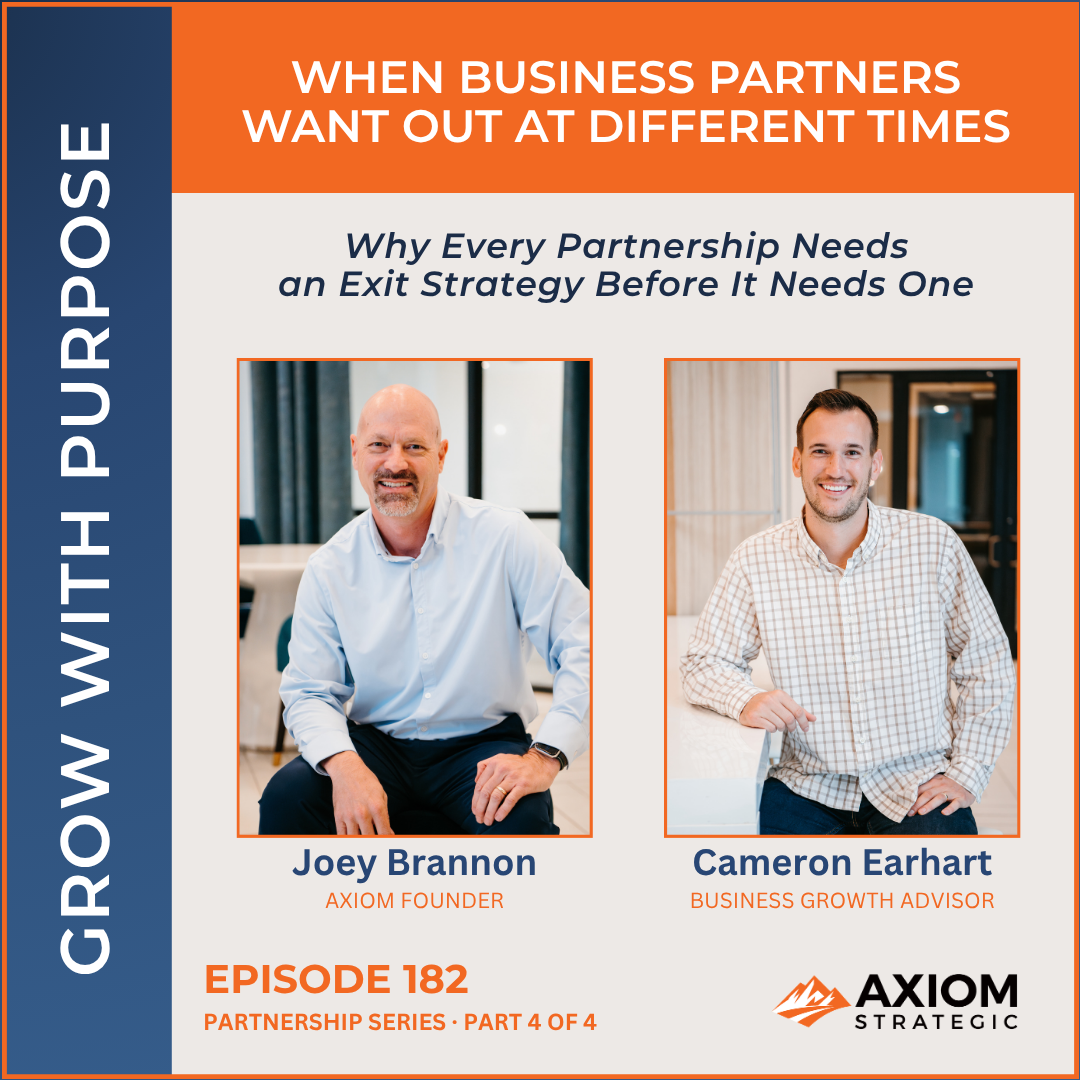
Over the last three episodes, we've covered operating agreements, role clarity, and vision alignment — the structure, the roles, and the direction.
This episode wraps up the series with the conversation most partners put off the longest.
Exit.
Not because they don't know it's coming. But because talking about it feels either too far away to matter or too uncomfortable to start. Cameron and I have seen what happens when that conversation gets avoided — and it's not pretty.
Every Exit Is Either Planned or Forced
The question isn't whether you'll exit. It's whether you'll be ready.
Everybody is going to exit their business at some point. Cameron put it plainly at the start of this episode: "It's either planned or it's forced."
Planned looks like two partners who've talked through their timelines, aligned on options, and built a business that gives them real choices when the time comes.
Forced looks like a divorce, a burnout, a health crisis, or a PE firm dangling a number that splits two partners who've never compared notes on what they actually want.
The most obvious version of misaligned timelines is an age gap — if your partner is ten or more years older or younger than you and you haven't talked about exit, you're headed for that conversation whether you want it or not. But age isn't the only thing that diverges timelines. Life changes. People get burned out. Opportunities appear. One partner gets a call that sounds like generational wealth and the other thinks selling now would be the stupidest thing they've ever done.
Cameron's estimate: somewhere between 30 and 50% of partnerships are on different exit timelines at any given point — and most of them haven't talked about it.
What We See When We Walk Into a New Business
One of the first things Axiom uncovers — and partners are often stunned by
One of the things we do in the first 30 days with a new client is a strategic assessment. We interview the owners separately. Same questions. Potentially very different answers.
Partner A:"I don't believe in retirement. My dad was 86 and died at his desk."
Partner B: "With the PE environment right now, I think in three to five years we could sell this thing. Stepping stone to generational wealth for my family."
Neither partner knew the other felt that way.
That's the 800-pound gorilla in the corner. And when Cameron and I come back from those interviews, we know exactly who has to go first in that room.
The longer those two partners go without having that conversation, the more decisions they're making — about leadership, capital, staffing, infrastructure — that are being made on two completely different assumptions about where this business is going.
How Today's Decisions Are Already Narrowing Your Options
A healthy business is a valuable business — but only if you've been building one
This is the part of the conversation that surprises most business owners.
Your exit options aren't decided at the closing table. They're decided in the day-to-day decisions you're making right now.
Cameron and I walked through the main exit paths — third-party sale, ESOP, internal buyout, recapitalization — and for each one, there are things happening inside a business today that are quietly taking options off the table.
Third-party sale: If your financials are a mess, you've been running personal expenses through the business, and all the sales run through one partner while all decisions run through the other — any serious buyer is going to find that in due diligence. You're not getting the multiple you imagined.
ESOP: If you haven't invested in a leadership team, if there's no culture of ownership, if people would see you leaving as instability rather than opportunity — an ESOP announcement isn't going to land the way you hope.
Internal buyout: If the partner being bought out can't be replaced without significant cost, if the business hasn't been generating distributions, if cash flow is tied up in reinvestment — that buyout math doesn't work the way either partner thinks it does.
The businesses that have the most options at exit are the ones that were being built right all along. A strong leadership team. Owners who've stepped back from day-to-day work. Clean financials. A culture that doesn't depend on the founders being in the room.
A healthy business is a valuable business. But health has to be built over time — not assembled in the 90 days before you go to market.
What Your Business Is Worth — And to Whom
The number in your head and the number on the table are rarely the same
Cameron said the number one surprise at exit is valuation.
Business owners come in with a number in their head — usually based on a multiple they heard about, a PE call they took, or a rough sense of what they think they've built. And then the market tells them something different.
We worked through a real scenario in this episode: a partner who had taken too many PE calls at teaser rates, convinced himself his half of the business was worth $10 million, and triggered a shotgun clause in the operating agreement — expecting his partner to either buy him out at that number or let him buy the whole thing and take it to PE.
What he didn't factor in: the business couldn't cash flow a $10 million buyout. The bank wouldn't lend that much given the capital already tied up. When we ran the actual math, the most the partner could realistically pay was about $6 million — which, as it turned out, was probably close to what those shares were actually worth.
The lesson isn't that the number was wrong. It's that value depends entirely on who's buying.
A PE firm with $1.2 billion to deploy and a mandate to invest is going to see a very different number than a partner who doesn't have cash in the bank because it's all wrapped up in the business. Same company. Very different buyer. Very different outcome.
The Case for Having the Hard Conversation Now
Don't avoid a difficult conversation just because it makes you uncomfortable
Cameron closed the series with something worth sitting with:
"Don't avoid a difficult conversation just because it makes you uncomfortable. You'll end up paying for it later."
For most of the business owners we work with, the business is their largest personal asset. In many cases, it's the foundation of their family's financial future. The stakes are that high.
And yet these conversations — about exit timelines, about what each partner actually wants, about what the business is really worth — get avoided for years. Not because people don't care. Because urgency hasn't forced it yet.
The problem with waiting for urgency is that urgency brings emotion. And when emotion rises, rational planning goes out the window. Decisions that should take months get made in days. Options that should have been built over years aren't there.
Joey connected it back to marriage: the most common reason partnerships — and marriages — fail is unmet expectations. I had expectations of you. You had expectations of me. We never compared notes. Now we're at a crisis moment.
It doesn't have to go that way.
The best time to have this conversation was at the beginning. The second-best time is now.
Key Takeaways
Every exit is either planned or forced — and the difference is whether you've had the conversation.
Between 30 and 50% of partnerships are on different exit timelines — most don't know it.
The decisions you're making today are either expanding or eliminating your future exit options.
A healthy business is a valuable business — and healthy has to be built over time.
What your business is worth depends entirely on who's buying.
Don't avoid the difficult conversation. You'll end up paying for it later.
Urgency and emotion make for bad decisions.Clarity and communication make for good ones.
The Leadership Guide for this episode includes a Partnership Exit Readiness Worksheet — questions to help you and your partner gauge where you stand on timelines, options, and the conversations you may have been putting off.
Download the guide. Work through it together. Grow with purpose.
References and Downloadable Resources
Leadership Guide: 182 — What Happens When Business Partners Want Out at Different Times?
Episode 179: Operating Agreements & Partnership Structure (ep. 1 of 4)
Episode 180: The Owner Hat vs. The Employee Hat (ep. 2 of 4)
Episode 181:Vision Alignment & Partnership Fit (ep. 3 of 4)