
185: Why Financial Independence Isn’t the Finish Line
What Comes Next for Families Who Want to Multiply Impact
There’s a point most business owners are working toward, whether they say it out loud or not.
It’s the moment where you stop asking, “Do we have enough?”
You’ve built something that works. The business is producing. There’s margin. There’s optionality. And for a lot of people, that becomes the goal over time.
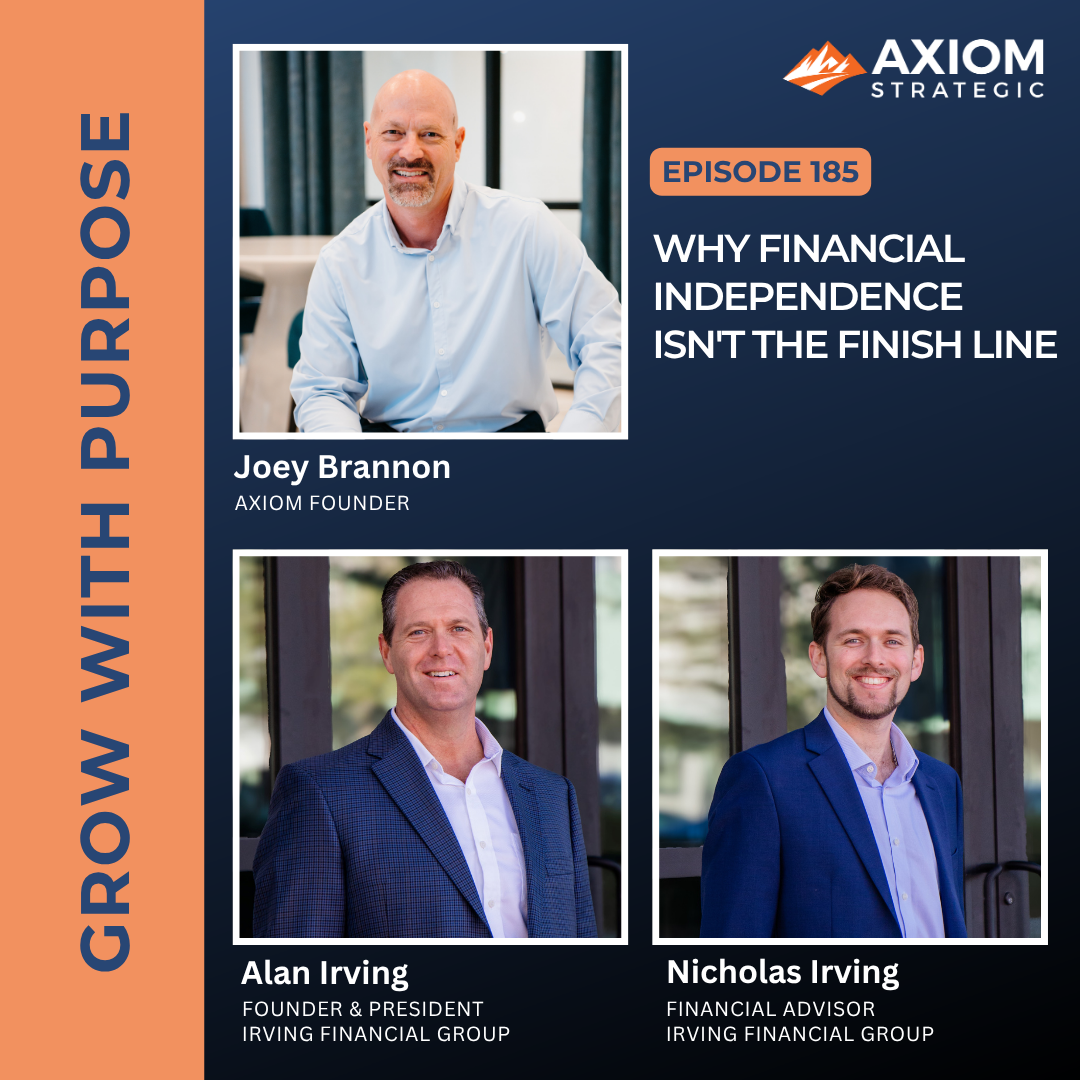
But sitting down with Alan and Nicholas Irving, what stood out to me wasn’t how to get there. It was what comes next.
After more than two decades working with families, they’ve seen what happens as people reach financial independence—and begin navigating what comes next.
And for some, that transition isn’t as clear as they expected.
Where This Perspective Comes From
This conversation wasn’t built on theory. Alan’s perspective was shaped early, working in a family business alongside his dad. During that time, he had a front-row seat to something that created more friction than clarity.
His dad had a CPA, an attorney, and a financial advisor. Each one was competent. Each one gave advice based on what they knew.
But none of them had the full picture. As a result, the guidance didn’t always align, and decisions became more complicated than they needed to be.
That experience led to a simple realization: when advisors are not aligned, it makes it harder to move forward with confidence.
When the Goal Doesn’t Fully Deliver
One of the more honest observations Alan shared is that they’ve seen clients retire and enjoy aspects of that season—travel, flexibility, time with family—but still wrestle with a lack of purpose.
Not because they made poor financial decisions.
Not because they failed to prepare.
But because they had spent years building toward a financial outcome without clearly defining what life would look like beyond it. That creates a gap.
And it’s a gap many people don’t recognize until they’re already there.
A Different Way to Think About the Goal
Instead of framing everything around retirement, Alan described how they’ve approached it with clients over the years as building toward a work optional lifestyle.
That shift changes the objective. The goal isn’t to stop working. It’s to remove the necessity of working.
And when that pressure is gone, the question becomes less about stepping away and more about what is worth continuing.
Getting Clear on What Money Is For
A lot of this conversation comes back to how money is viewed. Alan described it this way: money is a tool, not a trophy.
That distinction matters because it shifts the focus away from accumulation alone and toward purpose.
If money is the goal, the pursuit tends to continue without a clear endpoint. If it is a tool, then it requires clarity around what you’re actually using it for.
That’s where the conversation shifts from accumulation to intention.
The Difference Between Wealth and Being Rich
Nicholas added perspective from a younger generation navigating a different set of pressures.
There is a strong cultural push toward making money quickly and achieving visible success early. But he made the distinction that wealth is something different.
He described wealth as stored opportunity for future things.
That kind of approach typically takes longer to build, but it creates flexibility and options over time.
What Happens Beyond the Summit
For years, the focus has been helping people reach financial independence—the summit.
But as Alan has worked with clients over time, the question has expanded. What happens beyond it?
Because when people reach that stage, they often have more experience, more resources, and more time than they’ve had before.
And yet, many step away from contributing in the same way they had before. Not because they have to—but because that has been the traditional expectation.
The Conversation Families Tend to Avoid
As the conversation moves from individuals to families, another challenge becomes clear. Building wealth is one thing. Transferring it well is another.
Alan emphasized that values must transfer before wealth. Without that, wealth is more likely to create problems than long-term benefit.
One way this shows up in their own family is through an annual family meeting, where they talk through values, decisions, and direction together.
A Different Way to Think About Legacy
Alan also shared how his thinking around legacy has shifted.
Earlier on, the focus was on providing well and being remembered positively. Over time, that perspective changed toward strengthening the next generation.
Equipping them with what they need to lead, make decisions, and carry responsibility forward.
And that perspective shows up clearly in how they approach their work: their family serving your family for generations.
That changes the relationship and the time horizon.
Key Takeaways
Wealth is a tool, not a destination: It requires clarity around what it is meant to accomplish.
“Getting rich” and building wealth are not the same: Wealth creates long-term opportunity and flexibility.
Financial independence should lead to intentional decisions: Reaching that point changes the questions that need to be asked.
Values must transfer before wealth does: Without that foundation, wealth can create unintended challenges.
Legacy is built by strengthening the next generation: The focus shifts from being remembered to preparing others.
If you’re building a business and thinking about the future, this isn’t just a financial conversation. It’s a leadership one.
At some point, you’re going to reach a place where you have options.
The better question is not whether you can step away—but whether you’ve taken the time to define what comes next. Start there.
Take time this week—on your own or with your family—to answer one question: What are we actually building this for?
References and Downloadable Resources
Leadership Guide: 185 - Why Financial Independence Isn’t the Finish Line