
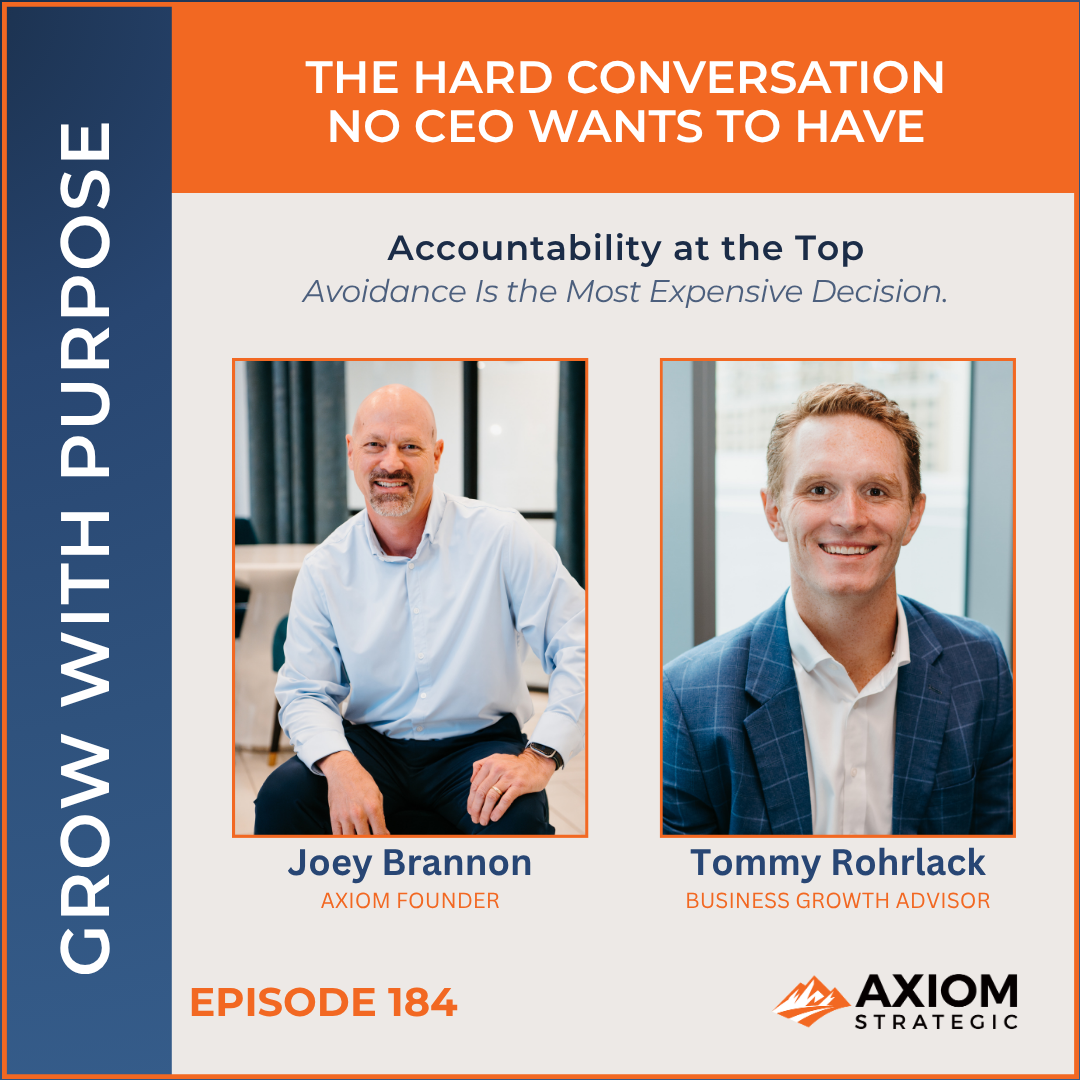
184: The Hard Conversation No CEO Wants to Have
Accountability at the Top
The Conversation That Costs More Every Day You Wait
There's a conversation most CEOs know they need to have. The leadership team knows it. The person sitting across the table probably knows it too.
And still, it doesn't happen.
I sat down with Axiom business growth advisor Tommy Rohrlack to talk about why these conversations are so hard to start, what it actually costs when they don't happen, and what clarity looks like when you finally stop avoiding it.
Hard conversations are hard because they matter
When someone on the leadership team is underperforming, the stakes are different than anywhere else in the organization. These are people who lead other people. The impact ripples in every direction.
Most of the time, the CEO has enormous investment in that person — time, trust, history, money. And that investment makes it tempting to hope things quietly improve.
They rarely do.
Every day you wait, the standard slips a little further. What could have been a hard-but-clear conversation becomes something much more complicated. As Tommy put it: avoidance feels easier in the moment, but it's almost always the most expensive decision you'll make.
Everybody already knows
Here's what business owners miss when they're afraid to bring it up: the rest of the leadership team already sees it.
The most competent, accountable people in your organization are not blind to the problem. They feel it. They're frustrated by it. And they're watching to see what you're going to do.
Herb Kelleher of Southwest Airlines is often credited with a principle along these lines: if you wake up thinking you need to let someone go, drive to the office and do it — because you're the only one who can, and everybody already knows it needs to happen.
Every day of delay sends its own message. And that message is that the standards you've set don't actually mean anything.
The warning sign most CEOs miss
A leader can be technically excellent and still be failing.
Someone earned their seat at the leadership table for a reason. They were great at what they did and they might still be. But technical excellence and leadership effectiveness are not the same thing.
The real question isn't whether this person is performing. It's whether the people they lead are thriving.
If the answer is no — and it's not a lack of effort or ability on the part of those direct reports — look up one level. That's almost always where the answer lives.
When coaching isn't enough
Coaching should never stop. But there's a difference between coaching someone through a growth edge and coaching someone who keeps nodding, walking out the door, and doing the exact opposite over and over again.
Tommy's test: if you can put your head on the pillow knowing you've done everything you can for that person in their role, and the same patterns keep showing up, coaching alone isn't going to get you there. That's when a reset is needed.
What clarity actually looks like
We've both been in rooms where the CEO came in prepared, knew what needed to be said and then didn't say it. Softened everything until the message barely registered.
In the film Moneyball, there's a scene where Billy Beane is coaching a young executive on how to deliver a difficult message to a player. The executive stumbles through it — vague, gentle, circling the real point. Beane stops him and cuts to it: do you want a slow death or a bullet to the head? Give it to them straight.
That's the standard for a leadership team conversation. Honoring someone means being clear — not cruel, but clear.
A clear conversation sounds like: here's what's going well, here's what's not, and here's what's going to change. And it means being ready for every question the person is going to ask before they ask it — compensation, title, how it gets communicated, whether this is temporary or permanent. If you're not ready for those questions, you'll end up in a follow-up meeting where they relitigate a decision that was already made.
Not having a plan for those questions is not a plan.
What delay actually costs
John Maxwell's Law of the Lid holds that a team will never outperform the leadership ceiling of its leader. The same principle applies inside a leadership team. One significantly off-pace leader doesn't average out with the rest — they counteract each one. The whole team operates well below its collective potential.
Stretch that out two or three years, and you're looking at missed execution on the strategic plan, financial goals that weren't hit, and a culture that drifted when it should have been building.
Jeremy Foley, the longtime athletic director at the University of Florida, captured it well when he made a difficult midseason coaching change: "If something needs to be done eventually, it must be done immediately."
These conversations don't get easier with time. They get harder. And the gap between what your business could be and what it actually is gets wider.
Key Takeaways
Hard conversations are hard because they matter — that's a reason to have them, not avoid them.
Delay signals that your standards are optional.
The warning sign isn't the leader's output — it's whether the people they lead are thriving.
When the same patterns keep showing up after every form of support, it's time for a reset.
One off-pace leader doesn't average out — they counteract each one, and the cost compounds.
The best time to have this conversation was before you needed to. The second-best time is now.
Download the Leadership Guide for this episode for reflection questions, a structured worksheet, and tools to help you prepare for the conversation you've been putting off. Download it through the show notes or at axiomstrategic.com. Grow with purpose.
References and Downloadable Resources
Leadership Guide:184 — The Hard Conversation No CEO Wants to Have
John Maxwell's: Law of the Lid
Jeremy Foley quote: Attributed to former University of Florida Athletic Director Jeremy Foley, widely cited from his 2004 midseason coaching change