
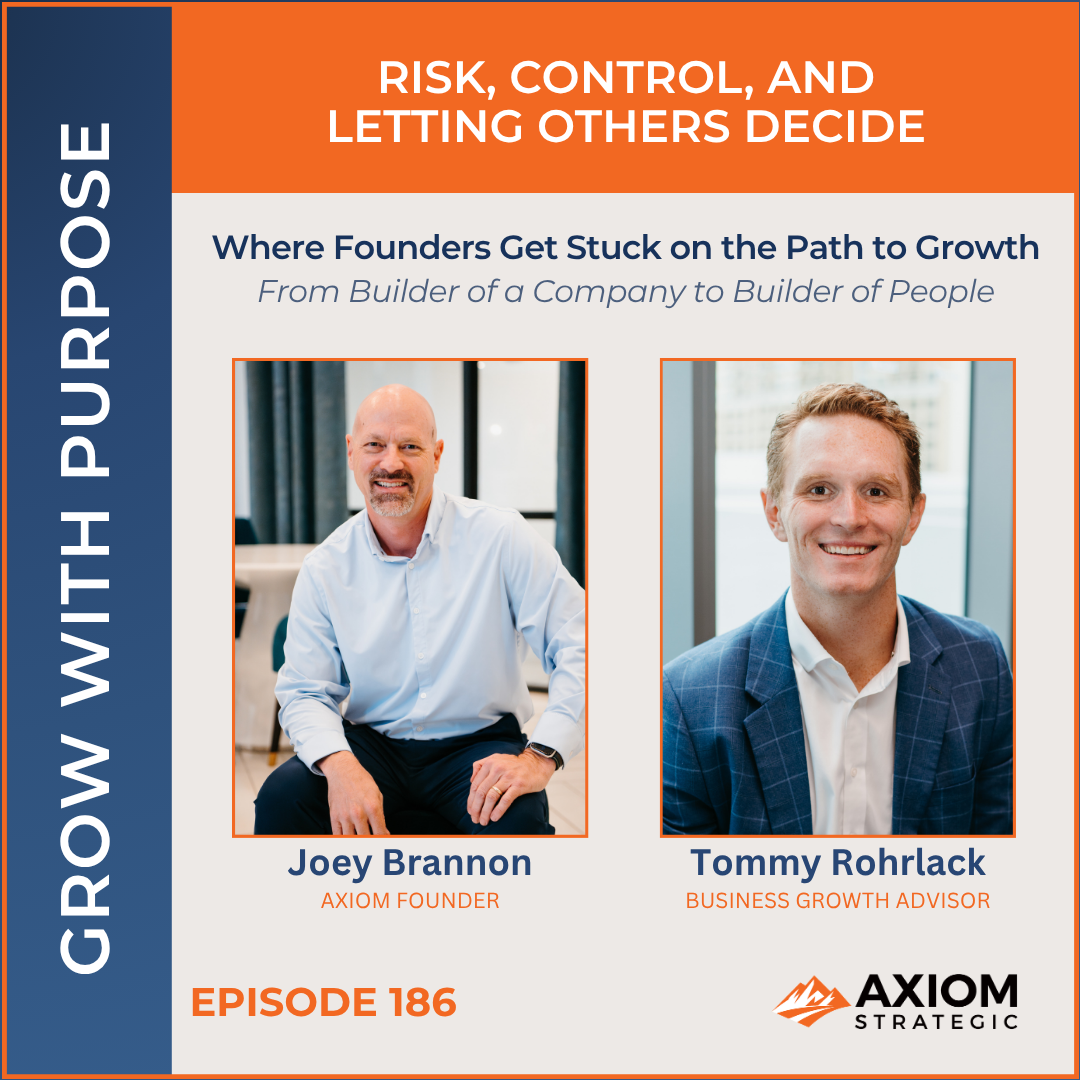
186: Risk, Control, and Letting Others Decide
Where Founders Get Stuck on the Path to Growth
Most founders I sit across from say the same thing. They want a leadership team that can run the business. They want people who can decide things without coming back to them every time. Then I look at the org chart, and the owner has fifteen direct reports.
That gap is the whole conversation.
In a recent episode of Grow With Purpose, Tommy Rohrlack and I talked through why that gap is so hard to close. What’s actually underneath the fear. And what changes when owners finally start handing over real decisions.
The Risk You’re Seeing Isn’t the Whole Risk
When a founder tells me they can’t afford to hand off a major customer relationship, they’re usually right about one thing. There is a real risk. If the person they hand it to drops the ball, the account could walk. That hurts.
But that’s the zoomed-in version of the picture. The zoomed-out version is the one most owners aren’t looking at. What’s the risk of never being able to grow accounts bigger than this one because you’re the only person who can service them? What’s the risk of staying capped where you are because you’re the only person making the call?
Loss aversion is part of why this happens. The pain of losing something is more powerful than the pleasure of gaining something equivalent. If I lost the phone in my pocket today, I’d feel worse about losing it than I would feel good about getting a brand new one. That’s how our brains work. The problem is when that wiring runs the company.
When an owner says, “I just can’t afford this risk,” there’s often a bigger risk hiding underneath. The risk of finding out the business can’t grow past the owner. The risk of finding out their people can’t handle bigger things. That’s the fear that’s harder to face, so the short-term loss aversion gets used to cover for it.
After twenty years of running my own business and a lot of risks that didn’t go the way I hoped, the risks always look bigger in the moment than they do a year or two down the road. They were never as big as they felt at the time.
The Org Chart Tells You Where You Are
People love revenue benchmarks. From one million to two. From three to five. From five to ten. I’ve seen those play out, but there’s a much simpler diagnostic.
Look at the org chart. Count the direct reports.
If the owner has more than four or five people reporting directly, you’re at a standstill. You may see short-term bumps. You may even see a stretch of growth, especially if the market hands you a windfall. We get hurricanes here on the Gulf Coast, and as much as nobody wants them, they’re good for business. Roofs, AC units, contractors busy for a year. But none of that is sustainable growth. That’s the market handing you something.
When more than five or six people report directly to the owner, two things happen. The owner burns out, or the people burn out. Sometimes both. You can’t keep growing under that structure for two or three years without one of those breaks happening.
Most clients we work with don’t have an org chart when we start. We put one on paper, and almost every time, we see the same pattern.
What’s Underneath the Need to Control
Fear of loss is one piece. Loss of a customer, loss of reputation, loss of the standard you’ve been holding for fifteen or twenty years. But fear isn’t the only thing. Identity is the other one, and it cuts two ways.
One way: “If I’m not the person on every job site, what am I?” That’s the loss-aversion version of identity. The job has been the identity, and giving up the job feels like giving up the self.
The other way is harder to talk about. A lot of owners don’t see themselves as leaders. I’ve sat across from owners with fifty employees who genuinely believe they’re not good at leading people. When we start talking about what it would take to grow the leadership capacity of their team, they get this depressed look. I’ve never been a good leader.
You built a $20 million business. You’ve got fifty people who think you hung the moon. You’ve been consistent, generous, and kept the doors open through hard years. Those are real leadership qualities. The block isn’t capability. It’s not seeing yourself as somebody who can become the next thing.
I had a client years ago who got to a point in our work together where he said, “All of this really hinges on me, doesn’t it?” I told him that was great news. He didn’t see how it could be. So I asked him to think back to the worst stretch he’d been through with one of his kids, a real situation where he didn’t know how he was going to find a way through. The frustration, the anxiety, the weight of it.
Then I asked him: “Is any of that present right now?” He said, all of it. He’d already flipped halfway through and started talking about the present. The emotions were the same. The mindset was the same. The obstacle was the same shape.
That’s the identity shift. Not believing you’re someone different. Recognizing you’ve already been that person before.
The Guardrails That Make Risk Wiser
When an owner finally starts handing over decisions, the question becomes: how do you do it without it being reckless? Three areas matter most.
The first is decision rights. What can this person decide? What can’t they? Most of the time, this isn’t communicated clearly. We talk to the owner, who says, “Sure, they can fire people in their department.” Then we talk to the person, and they have no idea they have that authority. Get explicit. What’s on the table, what’s off the table, what comes back to you.
The second is financial guardrails. The full P&L stays with the owner. But part of the financial picture should be moving over a department budget, a margin range, authority to take a lower margin on faster jobs. Define the financial impact you’re handing over, and how it gets measured.
The third is role clarity, and this is the biggest miss in almost every client we work with. There’s a general understanding of who does what, and most of that understanding is wrong. At Axiom we use a leadership framework that maps the business as an accountability chart — each seat is defined by what it owns, not who happens to be sitting in it. The seat exists because the business needs it.
Even handing over a small project, define where it fits in the person’s role, and what other roles it touches.
What Changes on the Other Side
The conversation I want to leave you with is one I’ve had a few times now with owners five or ten years past the point where they really started letting go. Sometimes it happens when they’re getting ready to exit. Sometimes when they finally bring in a general manager or replace themselves as CEO. Sometimes when there’s a brand-new opportunity in front of them they’re excited about going after.
You’d think the conversation would be about what they built. The revenue, the headcount, the trucks on the road, the reputation. They earned all of that. They deserve the credit.
But the conversation isn’t about what they built. It’s about the people sitting around the table.
“I am so proud of the people who are going to be doing this.”
That’s the line. That’s the shift. They’ve stopped seeing legacy as a revenue number and started seeing it as a group of people. Most of those people will eventually move on, and they’ll take a piece of what you built with them. So your influence isn’t one company anymore. It’s six or seven. Maybe more.
That’s the legacy worth holding out for. And it’s the one you don’t get if you keep holding on to every decision.
Key Takeaways
• The risk you’re seeing isn’t the whole risk. Loss aversion makes you focus on short-term loss and miss the bigger risk of staying capped.
• Count the direct reports, not the revenue. When too many people report to the owner, the business is at a structural ceiling.
• Identity blocks delegation more than fear does. Owners don't see themselves as leaders. The shift is recognizing they already are.
• Define decision rights, money, and roles before you hand them over. Most team conflict traces back to authority that was never made explicit.
• Legacy is a group of people, not a revenue number. The owners who let go end up most proud of who they built, not what they built.
Start with the org chart. Count the direct reports. Then pick one person, one decision area, and define the rights, the financial guardrails, and the role clarity around it. That’s the first move. The rest comes from doing it.
References and Downloadable Resources
Leadership Guide: 186 - Risk, Control, and Letting Others Decide
One Page Accountability Chart: Axiom Leadership Framework