
200: The Succession Trap - Why 70% of Businesses Can't Transfer Value
What Makes a Business Last Beyond Its Owner
Roughly 70% of businesses can't transfer the value their owners built to the next owner. Joey Brannon explains why succession is decided in a company's culture and leadership, and the operating rhythm that makes a business transferable whether you sell, hand it to family, or never sell.
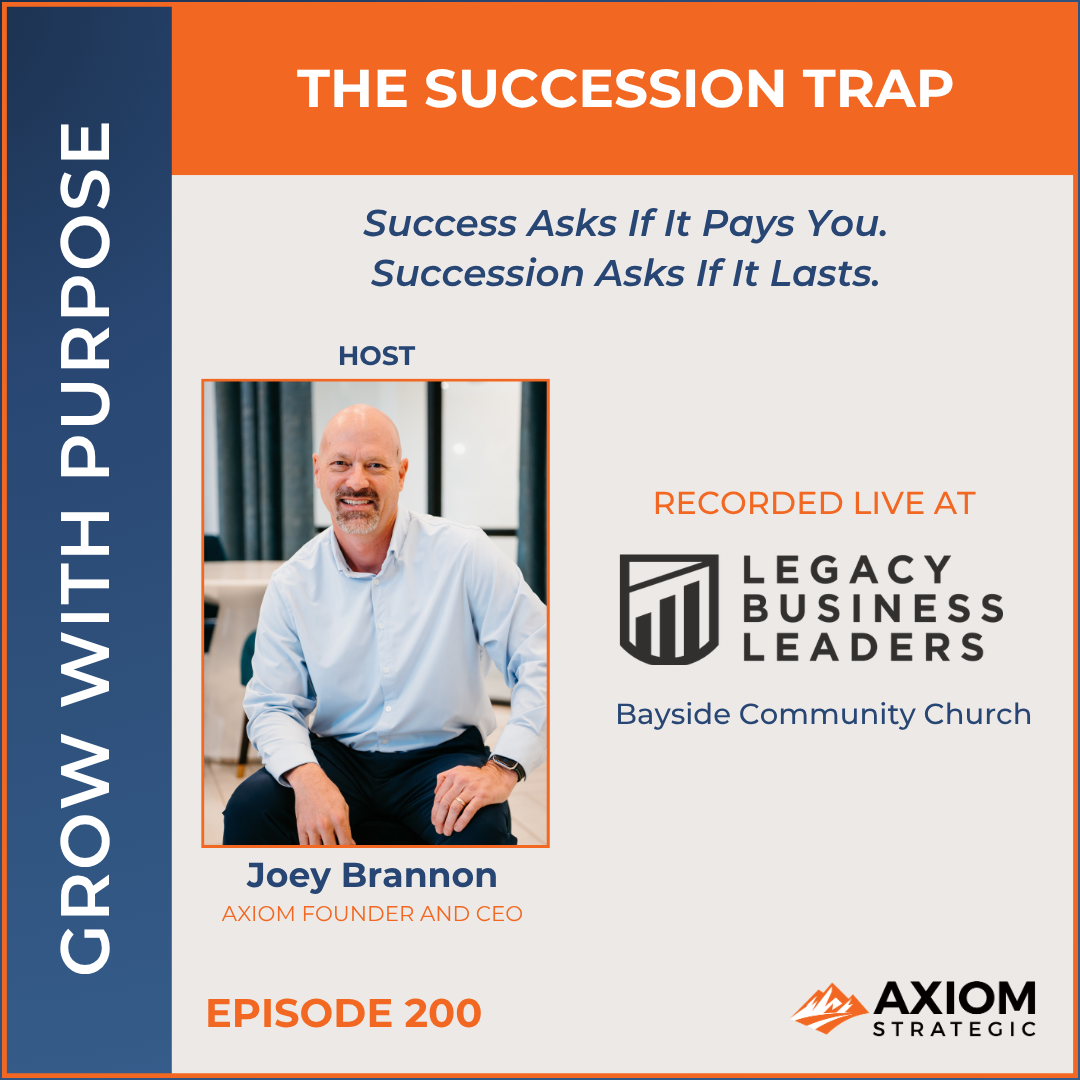
Host: Joey Brannon, CEO and Founder, Axiom Strategic | Recorded live at Legacy Business Leaders
Every business goes through succession. Some owners are well prepared for it, and some let it happen. In this talk to Legacy Business Leaders at Bayside Community Church, Joey Brannon lays out why success and succession ask different questions, why succession is decided in culture and leadership, and the operating rhythm Axiom runs with companies whether they plan to sell, hand the business to the next generation, or never sell at all. He closes with what the parable of the talents says about our responsibility to be ready.
In This Episode, You’ll Learn
Success asks if the business pays you. Succession asks if it outlives you.
What culture needs: defined values, a vision, a why, and a mission
How servant leaders encourage, exhort, and empower, and the question every buyer asks
The operating rhythm that makes a business transferable
Get the Q&A resource here: The Succession Trap: Q&A Topics. Every audience question from the event, answered, plus related episodes and resources.
References and Downloadable Resources
Grow With Purpose Podcast - 191: Not All PE Is the Devil
Read the deeper essay: Run Your Business Today Like It's Changing Hands Tomorrow
Frequently Asked Questions
What is the succession trap?
Fewer than 30% of businesses handed from a first generation to a second survive, and by the third generation the number is 12%. Only three out of 10 businesses that go to market find a buyer. Roughly 70% of businesses can't transfer value from one owner to the next.
What is the difference between success and succession?
Success asks whether the business pays you: financially, in lifestyle, in reputation, and in the ability to give generously. Succession asks whether the business will live beyond you.
What are the ways a business can go through succession?
A founding generation can hand the business to the next one. Employees can buy it, or the owner can set up an ESOP. A strategic buyer from another market can acquire it, or a private equity firm. Every owner goes through one of them eventually, prepared or not.
What does a buyer look at first when evaluating a business?
What happens when the owner leaves. The best evidence a buyer has is what happens while the owner is there. If every decision runs through the owner, the buyer assumes the business leaves with them.
What does a company culture need to support succession?
Four things: values with written definitions that everyone is held to, a vision that gives the team a destination, a why that makes that destination worthy of their best effort, and a mission that tells the team whether they won the day.
-
Episode 200 — The Succession Trap (Legacy Business Event)
Joey Brannon, CEO and Founder, Axiom Strategic | Recorded live at Legacy Business Leaders
This transcript has been lightly edited for readability.
Joey Brannon:
Welcome to Grow with Purpose. I am Joey Brannon, the founder of Axiom Strategic, and over the last 21 years, occasionally I get asked to speak in front of different types of groups. Could be industry associations, could be professional groups. In this case, recently I was asked to speak in front of a group of Christian business owners, and I’ll give a quick shout out here to Bayside Community Church, and my new friend David Parrish, who has started Legacy Business Leaders, and this is something I wish more churches would do.
The church needs to equip everybody that’s a part of that church, and Bayside identified that we’re not doing a great job of that in terms of business owners, and we yes, business owners are great for helping us fund our budget, and we should be doing that as business owners. We should be giving and supporting our the church that we call home. But Bayside saw an opportunity to equip business owners in a much fuller way, and David was the guy that they picked to to head that up a few years ago. I’ve been running for several years.
David reached out to me and said, “I have been getting a lot of questions from our members on the topic of succession, and succession can be family succession, moving from a founding generation to a first generation or first to second, second to third, that kind of stuff can be an employee buyout. It can be a private equity sale. There are 100 different ways that you can go through succession in your business. The big thing that we all need to realize is that we are going to go through succession at some point.
The only difference is some of us are going to be very well prepared for it, and some of us are just going to let it happen. So David’s group, legacy business leaders, big shout out to you guys, to David, to Bayside for what you’re doing. I love seeing business owners who are being intentional about succession. So we’re going to talk about all of that, and then I’m going to come back at the end. I’m going to tell you about a resource that we put together that came directly out of this group.
There were a lot of things that they kind of put on our plate, and we wanted to help them out, so we created something for this group, and we’re going to release it to the public as part of this podcast. So I will be back at the end to tell you about that. Here’s the talk that I gave to legacy business leaders. I’m going to start with a story. Once upon a time, there was a serial entrepreneur. This is like a business owner’s bedtime story. The serial entrepreneur, he had started three different companies.
The the legacy company, the one he started with, obviously the largest. A few years before this, he purchased a second company, and then he had a third that was just a almost startup phase. But for the largest company, he was trying to vertically integrate. He was getting beat out on pricing from China, and so he’s like, rather than beat them, join them. So he bought a vertically integrated company to supply some of his materials in China, and it was not going well, so he had decided I got to go there. I’m going to move my family over there.
Could be a year, could be two years. Don’t know. So he met with the three individuals running those companies, and he explained the situation to them. And they’re a little worried, a little scared, but you got to do what you got to do. Takes him about a year and a half, comes back. He could see the orders that were coming from the company that they purchased. So the Chinese company was sending product to America, and he saw that he saw the orders, but he really didn’t see anything else. He really kind of trusted this guy to run it.
Well, he gets back, and he had thought, well, this is probably good. It’s not bad. They’re probably replacing the orders they were getting domestically with the orders from our new sister company, and at least we’re not going backwards.
Joey Brannon:
Well, he gets back, and what he finds out is that the domestic orders had increased, and they had added the overseas orders. Their production had more than doubled, their profits were more than double, and he makes a decision right there and there. There’s no offense in me stepping back in as the CEO of this company. You’re the CEO now. I mean, you’ve done it for the last year and a half without me, and you’ve done a better job than I did. You’re the CEO, and I think it makes sense for you to have some equity in the business.
Goes to the company that’s like five years old, similar situation. Got more than doubled the business, so he makes the decision. You own this business now, not own it, but we want you to go out and we want you to do more acquisitions, do what you’ve done with this company, with others, and I’ll give you a piece of every acquisition you make because the startup, nothing’s changed. Same size, still issues. All kinds of stuff going on. Makes a decision. He’s got to fire that guy, replace him. He decides.
Well, I’m just going to fold it into the main company. This once upon a time story is not today. This is biblical. This is the story of the 10 talents. So why am I telling you a story about the 10 talents, a parable that Jesus told in Matthew and a different version in Luke, when we start talking about succession? You’re going to have to wait to find out. That’s my hook, right? We’re going to come back to that at the end. So, the succession trap. What is the trap? What is the 70% that I’m talking about?
The data tells us that fewer than 30% of the businesses that get handed off from a first generation to a second generation survive. That is survive. A fraction of those thrive and go on to outperform what mom and dad had created. The numbers are 12 percent for a third generation. I mean, we are blessed. We have 2/3-generation ownership companies that we work with, and I try to explain to these guys how rare they are, and I just don’t think they get it. But let’s say family is not. We you guys already have kind of hit on the topic.
Succession could be family. Succession could be that we sell. Only three out of 10 of the businesses that go to market find a buyer. So 70% of the businesses out there are incapable of transferring value from one owner to another owner, and that’s what we want to talk about. So success and succession. I was actually talking to my 11-year-old daughter about this talk, you know, because I’m hungry for an audience. I got to try it out on somebody, and she was captive. We were we were having breakfast Saturday morning, and she goes, “So is like succession?
Does that come from the word success? And I was like, “That’s a really good question, and it turns out that it doesn’t. They people think they’re related; they are not. Success is about outcomes. Success. When we talk about success, we’re talking about will the business pay me, and it can pay us in a lot of ways, right? It can pay us. It can get past that five-year mark that was already mentioned, right? I just want to get past. I want to get to the point where I don’t have to work for somebody else.
I can pay myself, be self-employed, be profitable enough for my lifestyle. Like I think I could make more money for myself. I could do better for my family working for me than I could for somebody else. Reputationally, this one’s a big one that we don’t talk about a lot. People want to be a successful business owner. That’s been my desire from the day in 2005 when Josey, my wife, gave me permission to go out on my own, I remind her of that often when it’s difficult.
You told me I could do this, and hopefully, if we’re if we’re warm-hearted, if our heart’s in the right place, if if we take our responsibilities seriously as children of God, then hopefully we also think I want this to to be able to give generously, right? But succession asks a totally different question.
Joey Brannon:
Succession says, “Will it live beyond me? Can it be passed on the next generation? Can we can we give it to the employees? Not give it. Can we sell it to the employees, or do some kind of ESOP? Can we have a strategic buyer? Maybe there’s somebody who would love to have a business in Sarasota or Manatee County, and and they’re not a competitor of yours because they’re in Kentucky or they’re in Ohio, and they’re like, “I’ll buy your business. You’re a roofer. I’m a roofer.
I would love to have an excuse to come and have business meetings in Sarasota, right? Or the big bad PE, right? I’ll just say like that. That was a great question. Shameless self promotion. We do a podcast at Axiom. Typically every week, there’s a new episode. We did an episode a few weeks ago that was titled “PE is not the devil, right? So that might be a good one for you to go back and listen to, because we cover some of those things. All right, so let me just kind of segue for a second and say, like, why why did David say, you know, Joey?
I think you could talk on this topic. For 20 plus years, we’ve been working inside businesses. We work with Cole’s business, and and what we do in a business like Kohl’s is we have an advisor who goes in and he helps that team build a plan to grow the business and then execute it. We stick around and we try we do the work with them and we make sure that we’re never in that spot where just like okay here’s your homework and then we leave and we don’t come back, you know, for three months or whatever.
In doing that work, we got to simplify things for ourselves first. We got to be able to break down the problems and understand what needs to be addressed first, second, third, fourth. So this is our framework. This is kind of what we hang our hat on in terms of how we look at a business, and it’s a pyramid, right? And it’s a pyramid for a reason because the base has to be the strongest part of the. Pyramid, it bears the most weight.
So when we go talk to a business, we also have to kind of impress upon them why they are in this order, and they’re in this order because when you’re experiencing a symptom in your business, you typically need to look below that for the cause. So I’ll give you an example. Financial health and profitability is at the top of the pyramid, and you say I’m not as profitable as I want to be. Well, most of we’ve all, if you’ve been in business long enough, you’ve gotten in over your head on overhead, right?
Started spending too much, got a little bit lax, you had to pull things back, make some. We all know how to do that. We don’t like it, but we know how to do it. Let’s say you’ve done that, and you’re still struggling. That’s a sales problem. Maybe you don’t know who you should be selling to, what price you should be selling at. You don’t know the market well enough. You don’t know how to message that product. That’s a sales and marketing function.
If we fix that, we can usually fix the sales problem and the financial health and profitability returns, but you say, Joey, no, no, no, no. We’ve we’ve done that. We paid a lot of money for that. We’ve done the market research. I know where all my competitors are. I know our unique value proposition. I know where pricing should be. Like we’ve done that. It can’t be that. Like well, let’s talk about your operations. Maybe you’ve got plenty of people walking through the front door, but there’s a group that’s walking out the back door that’s almost as big.
Maybe you have a retention problem. Maybe you can get the sale the first time, but the work product is so shoddy because there’s no system or process for consistently delivering an excellent customer experience that you can’t earn the second, the third, the fourth, the fifth order. You go no, no, no, no. We got that. Trust me. We have documented everything. We’ve hired experts.
Joey Brannon:
We’ve coached people from other companies that are systems and process experts, and there is not a shadow of a doubt in my mind that we have the process down. Well, let’s talk about your leadership team. Do you have the leaders who are capable of adapting that process that’s been built for everybody to the individual? Do you have leaders who can put the right people in the right places? Do you have leaders who can hold people accountable? No, no, no. We got that. We hired this guy two years ago. He used to run his own company. He got tired of it.
He’s a great leader. We got a couple of other people that have joined us recently, and we got some long timers. We I think we have the leadership team. Let’s talk about your culture. What are you guys trying to accomplish here? Do your employees know what the day should be about? Do you have a culture that’s capable of attracting and retaining the absolute best people, including the best leaders? So we start.
So when we go work with a business, we’ll spend like 30 days crawling through the business, interviewing a lot of people, trying to understand what’s going on, but when we when we hit go time after that first 30 days and we lay out for the owner everything that that has been going on, we do not pass go. We do not collect $100 until we have figured out culture. Now here’s what’s interesting: if we talk about success, success covers those top three layers. Everybody in this room is successful. I can almost guarantee it.
You don’t get to the point where you’re interested in this group without desiring success and having attained some of it. You also, I’ll tell you, you don’t get to this point where you guys can take two or three hours out of your day at your own discretion and tell other people handle it while I’m gone, I’m telling you, every single person in this room is successful. You have a certain amount of financial health and profitability that allows you to be here. You’ve had to figure out sales and marketing. A lot of you probably are still selling.
I know I’m still one of the chief salesperson in our small company, and you’ve had to operationalize some stuff, but if we’re going to talk about succession, we got to talk about the two that get missed. So that’s what we’re going to spend our time on. Now I’m going to leave some time for all the questions because those are great questions, and I can great I can give you great answers to those questions.
Not because I’m great, but just because I happen to have been doing this for 20 plus years, and I’ve seen enough situations, and I don’t like to repeat the same mistake twice, and so I can give you instances, and I’ll get through as many of those questions I can. But my hope is I’ll also point out all almost all the questions that were asked, not all of them, but like 80% of them they’re asked, have to do with an event. They have to do with when I’m ready to do this. What comes next?
I want you to leave today knowing that whether you want to sell this business in two years or tomorrow, or whether you want to hand it off to your kids, or whether you want to sell it to your employees, or whether you don’t want to sell it at all, you know what. You can start working on tomorrow, because what God has called us to do with our businesses is not get them ready to sell. He’s called us to use our businesses to build the kingdom, and I think the top part is easy. The hard part, the hard work, belongs in those bottom two tiers.
So if I can spend any time talking to you guys about anything, this is what I think is most important. So what is culture? Is it we get along great? We’re like family here, right? How many times people are there? We’re like family here. Well, so I’m going to go Thanksgiving in a few weeks, and that’s going to be probably one of the most dysfunctional lunches you have of the entire year, right? So that’s what family holds promise for, right? Extreme dysfunction.
Joey Brannon:
It has to be about something more. Now I just told you, like these are the things that we do. So what do we do? Like how do we do? We just leave it at that. No, my team has to know. Like if we’re going to focus on giving this company the bedrock of a good culture. What do we have to do? The first thing is values. Values are three to four words with definitions that describe the behavior that you are going to tolerate and the behavior you’re not going to tolerate.
They set the expectation for how you will be treated and how you will treat others, and they have to be non-negotiable. You have to be held accountable to these values. I have our core values are care, truth, diligence, and learning. I have been called out by members of my team for showing a lack of care. I’ve been called out by members of my team for showing a lack of diligence. And you know what? I am so so thankful because it mean if it if those values mean enough for them to confront their boss, then they actually mean something.
So I would encourage you if you don’t have three or four core values that are non-negotiable with definitions, you need to get those. The definitions are incredibly important. I won’t ask for a show of hands because I was embarrassed the last time I did this, so keep your hands down because I I said something like the most cliched value that I hate the most is integrity, and then for some reason I said how many people have the value integrity, and like three quarters of the room raised their hands.
I was like, all right, strike that one from the next talk. At least don’t raise your hands, but it’s not because integrity is a bad value. It’s because if all you have is integrity and truth and honesty and excellence on your conference room wall, or hanging in the lobby of your building, or on everybody’s screensaver, everybody’s free to interpret excellence the way they want to interpret it.
They’re free to interpret integrity the way they want to interpret it, and the thing about values is they’re the primary mechanism we use to appreciate people to get more of the behavior we want. When we see them living out the values, we call that out, and we tell them we retell them the story that they just lived out that gave us the ability to acknowledge them and appreciate them. But we also have to use our values to call out the behavior that we won’t tolerate, and I’ll tell you this: it’s rarely performance that causes the hard conversations.
Performance conversations are so easy because it’s like your sales quota was here; you haven’t hit it in three months. We can’t get, we can’t keep doing this. Our policy is you call the customer back within 24 hours, it’s been three days, and this keeps happening. Those are performance issues. The harder thing is the salesperson who did double or triple his quota, but there’s like a wake of dead bodies down the hallway every time he comes through the office.
That’s a values question, and if you don’t have definitions behind your values, and you say care is one of our values, and I just don’t see you caring for these people, and I need to call you out on that. And there’s no definition. He’s like, “What are you talking about? If they don’t do their job, we all go down. I’m caring for them incredibly well, right? And I’ve heard those conversations, but at Axiom, care means we love those we serve. There’s no grounds for misinterpreting that.
So when I say, “Hey, or when somebody says to me, “Joey, I didn’t see you caring for that client. You kind of got on your horse a little bit and you rode all over them. We’re supposed to love these people and we’re supposed to serve them. I don’t think they were feeling that way. I can hear that, and I can see that, and I can make changes. So values are super important. Next one, vision. Vision is where are you going? Where are you trying to get these people to? What is the journey that you’re all on together? If I said, what’s your name?
Speaker 1:
Lewis.
Joey Brannon:
Lewis. I said Louis. Louis. Somebody told me you like road trips. If you don’t like road trips, don’t say anything. But you you like road trips, right? So Lewis likes road trips. I say, Lewis, I heard you like road trips. I’m going on a trip. Come with me. I got snacks. I got a great playlist. I got a cooler full of drinks. I got a nice truck. It’s going to be a blast. And Lewis is like, I like road trips. I’m game, right? Lewis gets in the truck. He’s had a couple of Gatorades or whatever your favorite drink is. He’s gone through some snacks.
We’ve gone halfway through the playlist. We’re like 456, hours in. Besides looking for a rest stop to get rid of the Gatorade, what’s the other thing Lewis wants to know? Where are we going, right, Louis? What’s your favorite sport?
Speaker 2:
Football.
Joey Brannon:
Football. Who’s your favorite team?
Speaker 3:
Dolphins.
Joey Brannon:
Dolphins. All right. It’s not a long road trip, and it’s not very likely to happen. But let’s just leave it there. So, imagine though, I come to Lewis and I’m like, Lewis, you’re not going to believe it. I got two tickets to the Super Bowl where your Miami Dolphins are playing. They’re going to be in Atlanta at Mercedes-Benz Stadium. What do you say? Lewis jumps in the truck. He doesn’t care if there’s snacks, there’s water, anything. We get a flat tire. Lewis is out there helping me change it because we got to get to the game.
Traffic gets backed up outside Atlanta. He’s got an alternate route on his phone. We got to get there, right? The point is, if we don’t give our people a destination that we’re trying to get to, all we have to offer them is a paycheck for their time. And we see these surveys all the time that talk about lack of engagement. I want to see a survey that correlates lack of engagement with lack of vision, because I don’t think you can expect.
I don’t think you have a right to expect engagement from your employees to them to come in fully bought in, excited to be there, looking for problems, looking for solutions to problems. If you haven’t given them an over their horizon destination that you want to get to together. Now, the next one is probably more important. It’s why. Why is that vision worthy of everyone on your team’s best effort? As I said, we go through businesses like first 30 days, and we’re doing financial analysis, market analysis.
But what what we do that’s probably most visible is we do a ton of interviews. We do one-on-one interviews with a lot of people in the company. It was about 10 or 15 years ago. I was starting one of these, and we had we I sat down with this guy who’d been working for the country about five years, and they said we want you to talk to him because he’s an up-and-comer. He shows a lot of promise. He’s already our top field guy technician, and he’s probably going to be assistant service manager next stop.
And we think it’d be good for him because he could give you some insight into field ops. So I sat down with him. We had a great conversation. He had lots of ideas, and then I said, “Let me let me switch the conversation a little bit. I said, “What’s the vision for this company, and he thought for a second, and he said 35 feet, and I’d never heard that one before. And I’m like, you’re going to have to help me out. What’s 35 feet? He goes, well, here’s the thing.
Every morning, every single technician has to come all the way around the building to the backside of the building where the bay doors are, because that’s where all of our materials are staged. That’s where we pick up all the things that we have to to install that day. And in the back, behind that building, as we kind of round the corner, right in front of us is the back lot. You know, that’s where we keep a couple extra trailers, a couple extra trucks.
There’s a box truck that doesn’t get used very often, but right there, in that yard, is a 28-foot, beautiful center console fishing boat. That’s the owner’s fishing boat. Two years ago, that was a 23-foot boat. When I got here, it was a 19-foot boat. Every single guy that’s rounding that corner every morning knows the reason they’re working today is so that that 28 foot boat can turn into a 35 foot boat. That is not a vision worthy of their best effort.
So we owe it to our teams to be transparent with them about why the thing we want to pursue and we want them to come with us to pursue is worth their best effort, and what you find is when you can articulate that, it attracts people who want to do things for the same reasons that you want to do them, and that’s incredibly powerful to have somebody whose loyalty you don’t have to question because their motivations are the same. So why is incredibly important, and then the last one is mission. Mission is what tells us whether we won the day or not.
Joey Brannon:
Our mission statement. When you think about the origin of the word mission, it has a lot to do with the military. Can we win? Can we complete the mission? And the mission is not the war. The mission is not the battle. The mission is that little slice of what we have to do today. We have to go out, we have to get this person, we have to pick them up, and we have to get back safely, or we’ve got to go out and we’ve got to get to the top of this hill and we got to plant the flag, and that’s the completion of our mission.
Does your team know what it looks like to win every single day? Especially on the days when all the numbers went south, the AC technician went out there. He put four proposals in front of four people that needed air conditioning help, and none of them took it up on him. But can he still win the day? One of my favorite companies to work for, Tri County Air Conditioning, and they have a mission statement that is to comfort all in such a way that it honors Jesus Christ and compels them to tell about their experience.
So a technician can sell nothing that day and still win the mission. Now the likelihood that he wins the mission and doesn’t sell anything is extraordinarily unlikely, and their success proves that that point. All right, let’s talk about leadership. What is leadership? If culture requires those four things, and that’s not all it requires. I’m just telling you what’s in our playbook. I’m telling you what’s worked for clients. It’s worked for clients that transfer.
It’s worked for clients that sell, and I’ll tell you why it’s important in a minute, but leadership. What is leadership? First and foremost, it has to be servant-based. Leadership is not about a parking spot in the front of the building. It’s not about a position that’s near the top of the org chart. Leadership is about understanding your role is to serve others. Now, this is kind of cliche, but we look. We we literally tell people look at the org chart. I want you to look at the line above your name, the one that goes up, and you look at that person.
That’s the person who’s responsible for your success. And I want you to look down, and I want you to see the people that are down there. Those are the people you are responsible for their success, whatever resources they need, whatever training they need, whatever it is they need, it’s your job as the leader to provide it and serve them so that they can be successful. And usually, this is this doesn’t take a long. Everybody nods their head. Yes, I agree. We should not be authoritarian based. We shouldn’t be positional. I like this servant based idea.
Okay, great. What are we going to do with it? The first thing is you’re going to encourage. Encourage is the superpower of a leader. I’ll tell you another story. Working with this company for about been working for a long time, but about three or four years before we’d hired a new sales manager, guy named Sean, and we were I was in a meeting with their leadership team, and we-I was kind of hammering them with this. I was kind of giving them the two by four of the head of like, you guys.
We had a very clear opportunity, a thing that they were supposed to do to encourage somebody who had lived out of value, and they just weren’t doing it. They’re supposed to do this every week, and I was like, “You guys, we have to-we have to start living by this. And Sean goes. You know, you’re right. We we don’t do this the way we should. He goes. There was a time three years ago, and you guys know my first year here. We had a lot of early wins. Got the closing rate up, got a couple things done. There was just a lot of low hanging fruit.
And my first year, it was really good. And and you guys saw that for me and appreciated, and I like that. But years two and three were brutal. Every single day was just a slog. We had some toxic salespeople.
Joey Brannon:
We’re kind of reverting back to old habits, and it was just tough. I mean, those two years were some of the hardest I’ve ever had. During that time, I was walking out. It was the end of the day. I wasn’t the last person there, but you know people were kind of trickling out. I get like four steps into the parking lot, and I hear somebody call my name, and I turn around, and it’s the owner of the company, Gary. And Gary says, “Hey, hold up a second.
And he walks up to me and he says, “Sean, I know how difficult the last couple years have been, but I see what you’re doing. I know you’re doing the right thing, and I just want to tell you I appreciate it. Sean says, “That was the day I decided if you don’t want me here, you’re going to have to drag me out kicking and screaming, because I’m never leaving. I will come in here and bleed for this guy in this company every single day. We speak with a megaphone as leaders. We don’t have a low volume.
When you whisper, people hear it like it’s being shouted from the rooftop. If you’re a leader, if you own the business, and you walk down the hallway, downtrodden and sighing, and I don’t know what we’re going to do. People assume you’re going bankrupt, right? They think the company’s over. They’re like, “Do I need to go back and start polishing my resume? So, understand that when you encourage people, they hear it more loudly than they hear almost anything else in their life. They will go home. They’ll tell their spouses about it.
They’ll tell their kids about it. They’ll tell their neighbors about it. They’ll tell their their friends who wish they worked for a better company about it. Don’t miss it. The next one, exhortation. This is for those times when people miss the mark. They don’t get the job done, and we have to have a difficult. Conversation-not a hard conversation, but it’s uncomfortable. We have to say, Joey, you-you didn’t get this done. I know we talked about it, and I’m pretty sure you understand what needed to get done, but it didn’t happen.
And you need to do better. But here’s the thing: I know you can. I believe in you, and I’m willing to help you in whatever way you need. But this has to change. And if you look at any, I will guarantee you, if I went around the room, two out of three of you, because you’re successful, because you’re high performers, you’d be able to point back to a couple of those conversations in your own life, and you still remember them today, and you credit them with allowing you to do what you’ve been able to do since then.
So, if we’re not doing this for our people, we are taking away one of the most powerful things we can do to build them up for their future. So, don’t miss it. And then the last one is empowerment. They’ve they’ve deserved the encouragement. They’ve responded to the exhortation, and now it’s time for you to let go of some stuff. It’s time for you to create opportunity for them, and this is the scary part. This is the part that terrifies us because that’s a big account, that’s a big event, that’s a huge project. If we screw that up, it’s going to go.
Yeah, I know. But they’ve proven themselves over and over again. When they haven’t, they’ve responded very well. It’s time for you to give them the opportunity. And when you have this kind of servant-based leader, the whole point of servant-based Leadership is self-replication, exponential replication. If you have somebody who’s experiencing this, they’re on the receiving end of this. They start to emulate it. They start to understand this is how you make things happen.
If you’re not doing the job, if I’m going to be responsible for other people, if I’m going to move into a position of leadership, where I can lead others, and I have to depend on them to get the work done because I’m not in the field anymore, this is the best way to do it. I’m all in. And what we find there’s several other questions that that rely on this principle.
Joey Brannon:
If you’re going to sell a business, the person who’s going to buy it, their first question is, “What happens when you leave? And the best evidence they have for making that prediction is, “What happens when you’re here? If every decision runs through you, if nobody’s empowered to do anything, if you’re the only one who’s doling out the encouragement and the exhortation, they assume that when you leave, all that other stuff is going to leave too.
But if they can see that you’ve got a team, not just at the top level, but at the middle level, all the way down to the bottom, if they can see one of your employees demonstrating servant-based leadership to a customer, if they can watch one of your frontline employees encouraging somebody who’s had a bad day, or who has a beautiful home, or has taken really good care of their air conditioner or their car, whatever your line of business, and they say, “Man, you’re just doing a great job here. I got to tell you, I don’t see this often. Nice work.
If they can find a tactful way to exhort their colleagues who aren’t carrying their weight, if they can empower people without being the leader, you’ve got the makings of a phenomenal company. All right, so Joey, that’s great. We are all in. I think I got a lot of that stuff already. Got some notes. There’s some things I’m going to do different, but surely that’s not all there is to it, and it’s not. That’s just what you have to have that’s table stakes for what we’re going to talk about that drives value in a business and makes a business transferable.
So that leadership team, having established the culture and being the kind of people who will encourage, exhort, and empower from a servant-based attitude, now they have to actually get the work done. And the first thing that you need to do is set the strategic direction for the next two to three years. What we see all the time in businesses is a leadership team that is shell shocked by what we call the great idea grenade, right? The CEO who comes back from a conference and says, “We’re doing this now, right?
And he lobs it into the middle of the conference room, and everybody’s like, “Oh my gosh, right? Or my favorite, you know, I was talking to my neighbor the other day, and he said that they save a lot of money doing insurance captives, and I think you need you guys need to help us figure out how to do a captive. And I’m like, “Well, what business is your neighbor in? Well, he’s in the air conditioning business. How big is this company? That’s probably got like 30 or $40 million. All right.
Well, you’re an insurance broker, and we got $5 million and a really good professional liability policy. I’m not sure, and you got no equipment, right? But you come. We hear this stuff over the hedgerow all the time. It’s like we’re doing this, and your team. What happens is they just become desensitized to it. You come back from the conference, or you read the next book, and you’re like, “We’re going to do this, and you leave the room, and they may not say it out loud, but they’re all thinking the same thing: “This too shall pass. Right?
Just give it some time. You’ll forget about it, and then we’ll. But imagine how demoralizing it is for a team that puts their heart and soul into something, and then you come and pull the rug out from under them and decide to put that money or that time elsewhere. So these two to three-year strategic cycles prevent that. It allows us to give them the opportunity to focus. Strategy is just a fancy word for focus. That’s all it is. If we say our focus is going to be retention, that’s the thing that we have to get to.
Well, what happens when we have the opportunity to buy another company? We’re probably not going to do it. However, what if that other company has the industry, not just the industry’s best retention, like unheard of retention, and they’re for sale.
Joey Brannon:
Maybe we should look at that deal not because it’s a deal, but because we can buy the expertise that we’re struggling to create internally, and it fits with our strategy. So decide if I asked you what’s the thing that you and your team could focus on for the next two to three years, which is really hard for us. We want everything to happen this quarter, right? But if I said pick out something that’s going to take two to three years, what would it be? One thing. If everything’s a priority, nothing’s a priority. One thing.
That’s what your team needs to be focusing on. And what they’re going to do first is win the year on paper. We need to know what’s our revenue target, what’s our gross profit target, what’s our net income target. We also need to know on that retention number what’s our target. What would winning this year look like? If we’re at 68, we want to get to 85 this year. We’d like to go from 68 to 75, or 68 to 78. That’s the benchmark, right? Then the next thing we’re going to do is set 90-day priorities.
We’re going to break that year up into smaller, bite-sized pieces because the day we set that goal or that series of goals, they’re 364 days away. I got a pile of email from doing all this planning in this conference room all day. I got multiple fires I got to put out, and that’s 364 days away. So I’ll put that on the back burner for now. If it’s 79 or 89 days away, you it’s not much better. But what happens with these 90-day sprints is we pick the priority, and then our team we call them dominoes. How many weeks are in 90 days? Anybody want to guess?
13. Right? Makes sense. 13, 13, 13, 13. That’s 52. So you got 13 weeks to accomplish this thing. I’m only asking you to pick 10. In 10 of those weeks, what can you get done? And how can you line up those dominoes on the table so that when I tip over the first one, the other one’s already got some momentum, and we just execute every week to get that 90-day priority done. Now, when we start with a team, a lot of times what we’re doing is saying we got a team, leadership team of five people. What’s the priority for these five people?
What are we going to accomplish as a group? And we we walk before we run. After a couple of years, maybe a year, depending on how how good things are going, we might say these five people, you each are going to have a 90-day priority, and you each are going to have dominoes. And now we’ve 5x’d our ability to move the business forward. Once we have the 90-day sprints, we have to be accountable to the numbers.
Your team, I would strongly encourage anybody who’s thinking about succession, if you’re not pursuing open book management, which means allowing the leadership team to understand what’s happening from the top of the income statement all the way down to the bottom of the line, and from the top of the balance sheet, where the cash sits, all the way to the bottom, where the equity’s at, I I think you’re wasting a lot of your time and effort. We we could talk a lot about transactions, and there’s so much of the transaction that comes down to value.
How crazy is it that we want to maximize the value, but we won’t give the people responsible for creating it, the feedback loop that they need to help us do it. When we have clients who take us up on this, we will spend a year teaching people how to read financial statements. You can do a lot of damage by just throwing your P&L and your balance sheet in front of people who don’t know how to read it. They already assume that you’re taking buckets of cash out the business and stuffing it in your trunk every night, right?
When they see that $3 million cash balance, they forget that payroll every single week is $250,000.03, 100,000 is not a lot of money, right? So we have to teach them, and then finally, we get to weekly performance accountability.
Joey Brannon:
So again, that team is meeting same place, same time every week, holding each other. Accountable and working through the issues in the business. That’s our operating model. That’s what we do with companies. We do that with companies that don’t have any designs on selling or transferring. They got no kids in the business. They’re just like, I want to run the most profitable, best possible company I can. We have to do this with companies that want to sell to a third party, and we have to do it with companies that want to have a second generation take over.
Because if you think about the number one question that parents have is, is the second generation ready? If I have sat in a room with this person 52 times a year for the last three to four years, and I’ve understand whether they can deliver on the accountability. I understand their ability to discern what they should be working on the next 90 days, and they deliver and they hold people accountable and they’re living out that servant-based leadership. They’re encouraging, exhorting, empowering. Like, why are you asking me? They’ve been doing it.
The only thing that’s left is to give them more responsibility. So this is this is the path, right? This is the thing. Doesn’t matter what succession. All of our businesses are going to transition one day, unless unless Jesus comes back, right? And he goes, yeah, yeah, stay here, keep running it, right? Now you’re going to live forever, and you can be the CEO forever, right? Other than that, something is going to take me out of my business. It’s going to be my death. It’s going to be a sale. It’s going to be transfer to employee.
So there should be no difference between the way that I run my business today and the day that I get serious about doing that thing. I’m just leaving opportunity on the table. I’m going to skip the last slide because I don’t think it’s as important. Let me go back to the parable. Story of talents. I’ve heard this preached on. I’ve heard this talked about in small business CEO roundtables, and I’ve heard, oh, it’s about multiplication. It’s about stewardship. It’s about all this stuff.
And you know it’s funny when you read the Bible, you kind of see what comes before and after. And the parable that Jesus tells immediately before that is the story of the 10 virgins. We don’t talk about this one a lot. The 10 virgins, 10 virgins is the 10 ladies in the bridal party, and their responsibility is to wait for the groom. They’re waiting for him to return. He’s gone out, and they’re waiting for him to return so that they can start the banquet. And I imagine this is like early in the morning. Oh, he left.
You know, the banquet’s going to start when he gets back. And there’s, let’s say, there’s five five of the ladies over here. They don’t know when he’s coming back. They know this party’s going to go all night. So they’ve got their lamps ready. They got them oiled up. They’re ready. The others are like, well, you know, maybe he’ll come back in the middle of the day. We won’t need that oil, or we won’t need as much, right? But it starts getting later and later, and they hear the bridegroom. They hear him, but he hasn’t he hasn’t called them out yet.
And the ones who don’t have oil are getting really nervous. Like, hey, could you give us some of yours? They’re like, no, no, no. You got to go to the market like we did, and get your own because we might not have enough to last through the night. So the ones who didn’t, they leave to try to figure something out, and then the bridegroom comes. He says it’s time for the it’s time for the banquet. They go in, the others come back. It’s too late. They knock on the door. The bridegroom comes to the door, and and he says, “I don’t even know who you are.
Closes the door. The party continues. And then we hear the story about the 10 talents. What’s most interesting to me about the story of the 10 talents is it says that the the master left, and immediately the one with the 10 talents started trading.
Joey Brannon:
Says he started trading at once, and his 10 talents became 10 more. The story of the 10 talents is about our responsibility to be ready. God’s called you to run a business, he’s arranged circumstances in your life so that you’re the leader of the business, and I think he wants you to do more than just focus on what succession looks like. I think if you do that, you’ll be in the best possible place for succession.
Had a great conversation with David, and what God called him to because he did that well, and he exited, and then he was available for what came next. And you guys are all here because God called him to that next thing. There’s another story in the Bible. It’s not even a parable. The parables were where people were scratching their heads, and the disciples would often ask Jesus, like, “What are you talking about here? This didn’t make any sense to me.
But there’s another one about the guy who filled his barns up, but he still, you know, he still had more crop and not enough barn. So he says, “I know what I’m going to do. I’m going to knock them down. I’m going to build bigger ones, right? Not build bigger ones to to multiply his impact. Not build bigger ones to make a bigger difference in the.” Build bigger ones. Why? Because then I’ll be able to rest, and eat, and sleep, and be merry, drink margaritas on the beach after closing day, right?
And Jesus says, God came to him that night and said, “You fool! This very night, your soul will be required of you. And who’s going to be able to enjoy all this stuff.
So my encouragement to you is that the stuff that we’re talking about is incredibly important in the business world, but I want you to to follow that story of the rich fool to the end, because after that is where Jesus says, “You guys are worried about all these things: what you’re going to eat, what you’re going to drink, what you’re going to wear, and your father knows that you need them. Seek first His kingdom, and all of these things will be added to you. So I think by doing the things we’ve talked about, we are seeking first.
That’s my goal for you: is that you seek first. We’re going to stop the conversation there because what followed was a great Q and A session. We collected questions from the audience, and we had way more questions than we could get through in the Q and A session. So we we recorded as many of those as we could. Well, there’s so many that we couldn’t, we came back, and I answered every single one of those questions, and we put them on our website.
There is a free resource that was made available to that group, and we’re going to give you access to it as well. You can go to axiomstrategic.com/legacy-business-leaders, and you will see that complete Q and A resource, as well as links to podcast episodes, other resources that we’ve created that were answering a lot of the questions that they were asking. So go there, get that resource. That is going to take the place of the leadership guide this week.
We’re just going to send you straight to that thing that was created, and we will see you here next week.


