
Culture, Competency, and the Hard Call of Letting Someone Go
Joey Brannon explains why culture and competency are not an either/or, and why a culture miss has to be dealt with by day 60, before the culture pays for it.
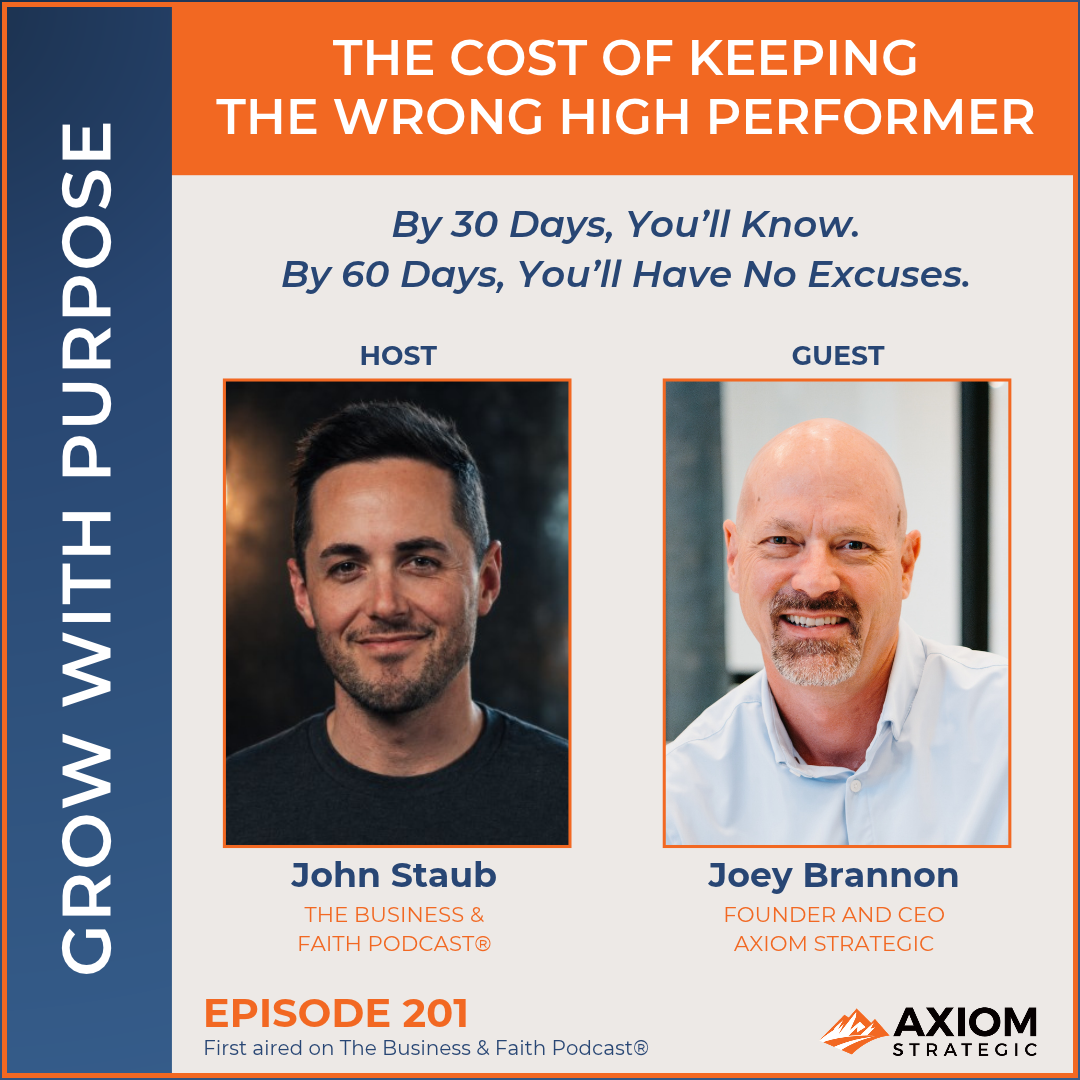
Host: John Staub, The Business & Faith Podcast® | Guest: Joey Brannon, CEO and Founder, Axiom Strategic
This episode first aired on The Business & Faith Podcast®, hosted by John Staub. Joey Brannon joins John to talk about culture, competency, and the hard calls that come with leading people, including why the onboarding plan should be written before the job is posted. Joey also talks plainly about his faith and about treating indecision as poor stewardship. Add The Business & Faith Podcast to your rotation at businessandfaithpodcast.com.
In This Episode, You’ll Learn
Why culture and competency are not an either/or
How values, vision, why, and mission define a culture
Why the onboarding plan gets written before the job is posted
Why you'll know by day 30 and have no excuses by day 60
References and Downloadable Resources
Grow with Purpose: Building a Mission-Driven Business by Joey Brannon
Read the deeper essay: Run Your Business Today Like It's Changing Hands Tomorrow
Frequently Asked Questions
Are culture and competency an either/or when you hire?
No. You need both. A salesperson who closes deals but nobody can stand to work with creates a problem for the team. So does someone who lives out the company’s values but can’t close a sale. Your onboarding process needs to measure both culture and competency.
What do the first 60 to 90 days of a hire reveal?
Whether the person can do the job and whether their actions match what they said in the interview about the company’s values and vision. Joey says you’ll know by 30 days and have no excuses by 60.
Why should the onboarding plan be written before the job is posted?
For leadership roles and the management layer below them, decide what you need from the role and plan the first weeks before recruiting. If the role already exists, review what has and hasn’t worked. That gives you a consistent standard before a candidate enters the picture. Joey’s example is a roofing field production manager who spends the first week with a different crew each day, even with 20 years of residential experience.
What does it cost the team when an owner waits too long on a culture miss?
The team pays the price for the friction that person creates, even if they’re getting projects done or making sales. Joey recalls a mentor framing it as a question of stewardship: when everyone, including the owner, agrees someone shouldn’t be there, delaying the change means running the business for that one person’s benefit.
How do values, vision, why, and mission define a culture?
Joey describes four parts:
Values: Three or four words with definitions that make clear which behaviors the company will promote and which it won’t tolerate.
Vision: An explicit finish line the whole team can see.
Why: The reason that vision is worth everyone’s best effort.
Mission: What the team completes each day, whether or not they close a deal or finish a project.
With those four in place, culture forms as the team does hard work together.
How does faith shape the decision to let someone go?
Joey says his faith makes the decision easier. He asks whether he believes he is in control of that person’s well-being or whether God is. When it’s clear to everyone that the person shouldn’t be there, he believes God has something else for them or may use the hard decision to speak truth into their life. He recalls someone returning years later to say it was the best thing for them. He views indecision as poor stewardship of wisdom, understanding, and discernment.
Listen to the full episode for more on hiring, onboarding, and protecting your company’s culture.
-
GROW WITH PURPOSE PODCAST
EP201 Episode Transcript
The Cost of Keeping the Wrong High Performer · Host: John Staub, The Business & Faith Podcast® · Guest: Joey Brannon, Axiom Strategic
Joey Brannon
In my early years, I was just young, dumb, and incredibly stupid. And I would say these words to clients: I'd be like, "It's not personal. It's just business. You just need to make the hard decision, right?" And then I don't know when it happened. Not long after that, I was like, "You're an idiot. It's all personal. Every single bit of this is personal."
John Staub
Welcome back to the Business and Faith Podcast, where we learn from leaders whose experience and faith have shaped how they grow their organizations on purpose. Today's guest is Joey Brannon, the founder and the CEO of Axiom Strategic Consulting in Lakewood Ranch, Florida. Joey is a CPA who has spent 21 years helping owners build mission-driven businesses. He wrote "Grow with Purpose" and posed a podcast by the exact same name. And in this conversation, Joey lays out why culture and competency are not an either-or.
Why the first 60 days tell you everything you need to know about a hire, and why the hardest call a leader makes is an act of stewardship. And now let's go on to the conversation that I got to have with Joey Brannon.
Joey Brannon
We don't want to have to pick the either or. I can either have the really competent salesperson who's breaking records and setting great numbers, but nobody can stand to be around. Right, production hates it when they turn in their paperwork because it's not complete. They sold something we can't deliver. You know that they back away from the sale and won't support us once we get into it.
And you know you like well we can pick that or we can pick the person who's just living out our company values, and they can never close anything. Right? We want both. So, when I think about culture versus competency, culture comes down to us comes down to four things. One, our values.
What are what are shared company values, and those have to be explicit. Three to four words with definitions that describe the behavior that's going to be promoted, encouraged, exhorted, and conversely, the behavior that's not going to be tolerated. So, values number one, vision. Where are we all going together? If we're trying to, what are we trying to accomplish?
Again, that has to be explicit. There has to be like some kind of finish line that we can see out there. Maybe it's five years. Maybe it's 10 years. Maybe it's 50 years.
But we've got to be on this journey together. And then, why is that vision worth our best effort? And then, mission. At the end of the day, whether we had a high ticket count or not, whether we closed a deal or not, whether we finished a project or not, were we able to complete the mission that's bigger than just the financial picture? So those four things, like that, to us defines culture in Axiom.
That's how we define culture for all of our clients. And once you have those four things, you just go out and you do really hard work together. And it's through the hard effort. We've all been in situations where you don't know somebody very well, but you got to do a really hard workout with them, or you go on this long hike, or you're on this three day canoe trip, and things are tipping over, and food's getting spoiled, and you're having to figure stuff out. And we come out of that if we've treated each other well, if we've accomplished the mission, if we've reached the goal, if we've all if we've done it for the same reasons, we're kind of motivated to do this for the same thing, we've done this hard thing together.
Now we have a culture, so those four things are important, but they're not necessary, but not sufficient. So when you're hiring somebody, if you get this luxury of bringing somebody in, like you have those four things, and a lot of your interview process needs to be like as we explain our values, what do those mean to you? You know, is that is that the kind of team you want to work on? Have there been past situations where you're like these values would have made a huge difference in the situations I was facing? Vision, are you excited about this thing, this destination we're trying to get to?
Do you see opportunity in this for you? Is this is this big enough that it's going to provide opportunity for a while, probably the most important question: Why are you motivated to join us and pursue that vision? Because if you and I believe the same things and we want to accomplish things for the same reasons, there's virtually nothing that we won't find our way over, across, through, under, around. Right, and then mission. You know, this mission statement.
It's going to be on the wall. Clients are going to see it. Customers are going to see it. People are going to be holding us accountable to it. How do you feel about that?
Now, people can give really good answers, and then we get into their first, you know, 60 to 90 days, and we find out two things. We find out whether all that stuff in the interview process was BS or they really believe it, right? But then the second thing is we figure out competency. Are they competent? You know, so those. So we want both. You got to measure both. You got to check in, like the onboarding process.
Joey Brannon
Again, we're just talking about new stuff, new employees. I'll come back to existing folks. That's a whole different animal. But we need to have the. First week, we got to know what they're doing almost every hour of every day.
Their second week, we got to know what their expectation is every day. Their third week, we got to know what the third, fourth, fifth week. We need to know what is their direction for that week. What are we hoping they can do to demonstrate that competency? And we have to we have to be very intentional with the onboarding because that's the work that's going to provide the kind of work crucible to measure competency.
But it's also where we're going to see if these values really mean anything, if they really believe in this vision, or they just said they did to get the job. And then you know they say you know hire slow, fire fast. I kind of believe in that. the area where I would differ is hire slow is really really hard when you're the one that has an empty seat in the organization, and every day it's not filled. You're missing sales, or projects are falling behind. So I understand why businesses struggle to hire slow, the best antidote for that is to get somebody else to do the hiring for you.
You know that's something that we had to start doing for clients because the teams were growing and we needed to add people, but the recruiters weren't adding the right people, or they're pulling the internal people were pulling the trigger too early. We weren't letting the process work itself out. So if you can, you know, delegate a timeline and just you know somebody else who's going to be looking for the right things and not just looking to fill a seat. Then you can hire slow. But the fire fast part is, I would say, you know, I'm not saying the first week. If something happens in the first week, you probably didn't have a really good process for
Joey Brannon
hiring. But I would say between 30 and 60 days. If you're not willing to upset the apple cart and let somebody go, your culture is going to pay a horrendous price. And so we don't typically have a problem firing people early for competency. Like obvious, they lied on their application or the resume was padded, or the references were nonsense.
We can see that. We're like, look, this just isn't going to work. But it's that person that they come out of the gate storming. They're getting projects done. They're making sales, but they're saying some things.
There's some friction in the office. The new team is kind of they don't really trust them yet. You're like, well, let's just give it some more time. I'm sure they'll come around, right? And as the owner, I love this quote I heard in a talk.
I can't remember who said it, but it's attributed to Herb Kelleher, who started Southwest Airlines. And he said, "If you're in the shower in the morning and you realize the thought comes to you, I should probably just let this person go. The first thing you should do is drive to the office, and the first thing you should do when you get there is let them go for two reasons. Number one, by the time you realize that, everybody else already believes that. Everybody else knows that's probably the only solution.
And number two, the fact that it hasn't happened yet is probably an indication you're the only person with the authority to actually make it happen. So I'd like to see more business owners, you know, get involved in protecting that culture by, you know, 30 to 60 days. If we're seeing a miss on culture alignment, then we just got to let them go. And man, it's painful because the empty seat is back again, especially if that seat was like really producing and sales are coming in. And now we're giving up another.
You know, it took three months to hire this person. Took two months to fire him. We're basically rolling the clock back. We've lost the last five months. But I mean, I've I had I've had to do this in the last year, and that was the most painful part.
Was man, we are losing months of progress against our growth plan. But God has a way of making all that ground up faster than we imagine. You know, you get the right person, and you know, I think part of this is being faithful and being a good steward of what He's given you. And you know, stewards have to make the hard choices that other people don't get to make.
John Staub
Yeah, you've brought us all the way back to mission and the gift of stewardship as a leader. The responsibility right there must be considered when you're trying to make a difficult decision. Is that, as Andy Stanley would put it, a yes to one thing is a no to another. A no to one thing is a yes to another. You know, I appreciate you deliberating on the hire slow, fire fast.
It doesn't. It's not quite as clean as that in practice. But the issues that you are facing in the mornings, when you're getting ready, that if you're thinking about something, what is most likely happening is this problem has not just occurred. There were problems preceding this that have led up to this. They that probably, if I lean in as a leader, we've probably made the wrong choices.
Leading up to that moment where it's preoccupying our like pre-work headspace, and so I love the way you reference the 60 to 90 days. Is that something that you recommend to people out of the gate when somebody's hiring to say, "Hey, we have this probationary period. We're going to keep track of things. Make sure it's a good fit for both of us. How does that practically look?
Do you actually communicate it? How have you seen that works? Because I think sometimes the exit ramp for an employee to feel maybe like they're stuck is I do think that's a two way street. But mechanistically, what how do you advise people in that 60 to 90 day early period. Do you communicate it? Because I'm assuming it gets uncomfortable when we haven't communicated the process ahead of time. Yeah,
Joey Brannon
I mean it's kind of different depending on the level of responsibility and the role, the position that that you're talking about. But if we have a client who has a leadership team role to fill. So these are going to be the top four or five people in the company, or a management layer like one step below that. We really strongly advocate that they take the kind of framework that we have for bringing people on and fully build it out before they ever start thinking about recruiting or placing an ad or any of that stuff, and it starts with like really rudimentary stuff.
Like quantify the need. Like, why do we need to hire this person? We're talking almost always we're talking about adding pure overhead. If it's a sales position or if it's a new field crew, like just go get them. Like this, that's money that's just not that's out there in the market that we can't get because we don't have the people.
But most of the time, these are positions that are going to take directly from the bottom line. So we want to make sure that we quantify the need. Then we really need to think about what is the if it's replacing a role or responsibility that already existed. Maybe somebody left, retired, whatever. Then this is a great opportunity for us to say like what was working well in that role before and what wasn't.
We this is our opportunity to redefine it without pulling the rug out from under anybody or having to have some kind of awkward conversation about you're doing this and we're going to hand it to so and so now. So getting your kind of dominoes lined up in the beginning before you go to market, the and the biggest thing that most companies miss and they roll their eyes and like ah we've got you said the process is going to take three months. We can do that later. It's like, no, no, no. We need to go ahead and scope out that onboarding pathway now.
Let's think about it before we have, because what's going to happen is we're going to interview some candidates, and let's say we're hiring for a roofing field production manager, and as the team sits around the table, you know it's like, what do we want? Well, we want experience. We want this. We want that. Okay, but what kind of experience?
You know, we want this is going to be primarily residential. Are we okay if somebody's got a lot of commercial experience and maybe their residential was 15 years ago or not? Because we'll just we'll decide all those questions, and we'll say, you know what? No matter what, we do things differently than everybody else. So week one, we're going to put them with one crew every day, different crew every day for the first week, because we just want them to just watch and see the interactions of the crews.
These are people are going to be holding accountable. We want them to spend the first week out in the field. If you don't do that, what happens is you get to the person, and we've got a candidate, and they've got 20 years of residential roofing experience. They've been doing this exact same job for a company in another state or on the other side of town, and man, we couldn't ask for anybody better. And then somebody goes, "Well, you know, we need to put them in the field for the first week, and everybody goes, "Why would we do that?" They're doing that today.
They're doing that yesterday. They're doing that day before. We can skip that part, right? But when we are trying to decide in that first 60 to 90 days, is their culture alignment? Is there competency?
We need to decide what is the bar by which we're going to measure everybody who comes through this gate, and so if you can disconnect the particular candidate's name because they don't exist yet from the process that we would want anybody to go through, we're at the point at the beginning we're talking about our ideal candidate, the person who has the cultural alignment and the person who has the extraordinary competency. So why would we lower the standard and just start the process?
Joey Brannon
Be like, well, we'll settle for great competency, but we'll hope that the culture comes along. So deciding first week, second week, third week, first month, second month. I'm telling you, if you do that by day 30, you will know you're probably because a lot of the business owners that we work with, not all of them, but a lot of them, come from a strong faith background. They love people. There's this misnomer that business is, you know, all about greed.
Let me tell you something: the greedy ones they don't exist after five or 10 years, right? The customers figure out they're greedy. The suppliers figure out they're greedy. Competitors. Figure out they're greedy and undercut them on price, and they get driven out of the market.
The ones that we get to work with are some of the most generous, kind-hearted, just loving people. They just like to love on people. Now they all have their own style of doing that, but when push comes to shove, 30-day mark, this is probably not the right person. There's a part of them, the merciful, the generous, the grace-giving part is me like, well, let's give it a few more weeks, right? And everybody else rolls their eyes, but it's like, okay, but I would want the same if I were in that position.
So, it just makes that onboarding plan by 30 days, you'll know. By 60 days, you'll have no excuses. And then, you know, you talked about stewardship. You know we've had to have this conversation, and I had a mentor of mine have it with me. Of okay, let's talk about this because you knew a month ago that you should have made a change.
It's been four weeks since you still haven't made the change. So now let's talk about who's really coming first. Is this God's business or is this your business? Clearly, it's your business, right? We've established that, right?
Because we both agreed that if this didn't happen, God was telling you need to let this person go. So we know it's your business. Now let's talk about who's coming first in this business. Is this your existing team members who've been giving you years and years of blood, sweat, and tears? Is this the family, your family, that depends on this business for their, you know, keep a roof over their head?
Is this the families of the other people who are part of this team who are having to hear every single day about this toxic person that's on the team that dragging everything down? So who is this about? When we're talking about stewardship, who are we stewarding it for now? It's not even you. We're actually stewarding this.
We're running this business for the benefit of this person that everybody, including you, agrees shouldn't be here. But you're the only one who can make the decision. And you know, it's I used to, you know, I've been axioms 21 years. You know, and in my early years, I was just young, dumb, and incredibly stupid. And I would say these words to clients: I'd be like, "It's not personal.
It's just business. You just need to make the hard decision, right?" And then I don't know when it happened. Not long after that, I was like, "You're an idiot. It's all personal. Every single bit of this is personal.
It is. We're affecting the lives of people, they give more time, energy, effort, more concentrated effort, and more time to our businesses than they give to anything else in their life. Nothing else in their life gets 40 hours of attention per week, and you could quibble over. Well, they're not, you know, they're not that engaged. Don't give them too much credit.
Look, they show up for 40 hours a week, they don't show up for 40 hours a week with their wife or their kids or their neighbors or their other family members. They give that to you, so it's incredibly personal, and you need to honor it. But the thing that we going back to the faith side of this makes it so much easier. Like if you if you look at what the Bible says, and it speaks truth into every area of life.
Joey Brannon
And you go, do I believe I'm in control of this person's well-being and welfare, or do I believe God's ultimately in control of it? Because if I believe God's in control of it, and it's clear to everybody, this person shouldn't be here. God has something for that person somewhere else, or He's waiting to use the hard decision that I have to make to speak truth into their life that's going to change their life, and that has happened to me. I have had to make a decision I didn't want to make, and fortunately, years later, somebody comes back and says that was I didn't think it at the time, but it was the best thing for me, and thank you.
And you know one guy that we had working with us, phenomenally talented, amazing individual, but you know his personal situation he needed to go off and do something else, and it was going to require him to move to another market. And I said, we're just not going to be in that market. It's going to take you another year to build a market presence there, and that's another year of me carrying overhead. I just can't afford that, and so you know he had his priorities straight. You know, it's not that he was doing something I didn't think he'd do.
He should have. He should be doing it, but it wasn't something that I could fund. And he went and started his own business. He's doing so much better than he would have ever done here. It's phenomenal, right?
So, you know, God is in control. If we're faithful, we just have to say, "Hey, give me the wisdom, the insight, the discernment to not only make the best decision, but to carry it out in a way that honors and pleases you, knowing that there's a really good chance this person is not going to like it, but I'm you know do it care truth and love, and um and just be like okay Lord I know that one day I'm going to stand before you and you're going to say you did a good job there and you couldn't see where that was going I could maybe it caused you great pain and suffering you know maybe it caused you know to.
Have to learn perseverance and character, you know. He his ways are not our ways, you know. So we just have to. I do believe he's blessed us with extraordinary wisdom, insight, understanding if we seek it, if we're humble enough to receive it. But all of that will require action at some point. You're gonna have to indecision is
John Staub
still decision.
Joey Brannon
It's poor stewardship of wisdom, understanding, and discernment.
John Staub
Yeah, absolutely. I want to go back to mission because to me, when you understand mission of what you've been entrusted by God to lead the organization or your part of the organization, you have that mission there. I also believe that your team deserves from you as a leader to stand up for the mission they're giving their lives for. Obviously, they need to get enough money that makes the mission that they're chasing worth their economic while. Of course, but people are giving their lives, especially if you go down into the millennials and Gen Zs that are working.
They want to chase a mission. Now, I wanted to get some advice from you on the concept of mission. I've seen this applied across the board. I've seen the BHAGs of these, you know, big hairy audacious goals. I've also seen kind of the mission where it's almost this carrot that they keep moving ahead of us, maybe moving the goalposts, so to speak.
I, I'm fascinated by this concept because I love a mission that we can chase and eventually fulfill. So I, I'm okay with all of that. What's the best way to get everyone around a mission? Obviously, we talked about how to evaluate new people into the organization. That's one thing.
That's kind of assuming that we have a mission for people who are really wanting to drill down on a mission to get their people around, so that we can make hard decisions because the mission is worth those hard decisions. How do you walk people through the process of a mission that we can chase that gets us all together, but can also be measured, but then doesn't just keep feeling like a carrot that's getting dragged in front of our face? Yeah.
Joey Brannon
Well, you know, I think it's important to kind of define semantics here. So we talk about mission being this thing that sits on top of a three-legged stool, and the three legs of the stool are the things we've talked about: values, vision, and why. Why is that vision worthy of everyone's best effort? Because if you haven't done that homework, if you don't know what are the non-negotiable standards for behavior in terms of values, then we're going to be hurting people. We're going to cause hurt feelings.
We're going to be tolerating toxic people. All of that stuff. If we don't understand the vision, it's like the vision is kind of in the in the military analogy. the vision is the winning of the war. So if we don't understand the game that we're playing, if we don't understand the thing that we're trying to win in the big scale, then you know what is the mission, and if we don't understand why that vision is worth everyone's best effort, then we're going to attract people who have different motives from us, and we're just all going to be extraordinarily frustrated because we're doing the same.
There's nothing more frustrating than doing the same thing for different reasons. So if you've got those three things, if you've done that homework, then you say, okay, well, what's your mission statement? What's the and going back to the military analogy, the mission is the mission for the day. Like a battle is a series of many many many missions, and a war is a series of many many many battles. So when we talk about, I think it's important to talk about mission as the thing that your people can focus on in the day on the daily basis.
One of the best examples I have from a client, I'll give them a shout out. Tri County Air Conditioning. We worked with them for a lot of years, still do. And the mission of the organization, they're HVAC company. The mission of the organization is to comfort all in such a way that it honors the great Comforter Jesus Christ, such that they are compelled to tell others about their experience.
So, if you think about that, you've got an HVAC tech, and everything he's tried has not worked. Maybe, maybe it's even worse than that. We installed this brand new unit, and it stopped working. And the team that installed it, they're off to another job. I got called here.
I got to fix this thing. Nothing's working. We our job is to comfort all. Number one, physical comfort. These people are discomforted, right?
They they're sitting in a house in Southwest Florida. It's 95 degrees. It's 80 percent relative humidity, and they are not comfortable. So how can I comfort them? I can get temporary units from the warehouse.
I can put them in the bedrooms. At least they'll be able to sleep tonight. I can call the distributor see if we can expedite that part. Maybe. Maybe we get the whole pull the whole unit out tomorrow and figure it out then.
But the second part of that in such a way that they are compelled to tell others about their experience. So that tech is sitting there in the in the driveway thinking, I need to communicate as clearly as I can how sorry I am, how we screwed this up. How we're owning the failure. How it's my failure, even though I wasn't the one to install it. I'm representing the team that did, and so I'm gonna I'm gonna take ownership of that, and I'm gonna communicate everything that I plan to do, and I'm gonna make sure that somebody follows up when I get back to the office.
I'm gonna call back dispatch and see if those units have arrived. Right, and at the end of the day, we talk about you know creating raving fans. That that book that came out 20 or 30 years ago. These opportunities present themselves in moments of extraordinary you know pain, discomfort, things going sideways, fires being built. So that's kind of the litmus test that I use for mission statements. And everything's going sideways. Can we still do? We still have an objective we can still meet.
Joey Brannon
You know, if you go if it's a military mission, and the objective is to take that hill, and the route that we're going up, we can't make it up there. Who cares which way we get up? The objective is to take the hill. So, are you giving your people a way to take the hill that gives them the discretion to pick the route? You know, maybe take the hill means calling a helicopter.
Like I can't fly, I can't get, but I can get somebody who can get to the top of that hill, and we will be able to say we check that box. So now, how do you get people to do that? That's a function of leadership. So leaders have three things that I think that they number one, they miss their superpower. The leader superpower is encouragement.
You, if you will lean in to your ability to encourage people, when you find people that are completing the mission or who are just giving it their best effort, and because maybe competency, maybe experience, maybe whatever they failed. But you can encourage them and say, "I know, I can see the effort. I can see how hard you're working. By the way, I see that the way that you're working this is completely consistent with our values. I know what you're.
You get what we're trying to do here. I believe that you can do this. I just want to recognize what you've what you've done so far. That person will run through walls for you. The second thing that leaders have to do is exhort.
Exhortation is for the people who fall short, and it's saying you didn't hit your numbers. I've kind of been watching. Time and task management is a struggle for you. Prioritization is a struggle for you, but I believe in you. I know you can do this.
It's my job to get you the help that you need. But you know, hitting the standard is a requirement. So, what help do you need? What's my job for you as your leader over the next 30 days, so that you can begin to hit this standard. Because I believe you can.
And then the third responsibility of a leader is empowerment. So the people you encouraged, you know, they they're doing the small things well. You started pushing them to bigger things. Then they had to get exhorted because they were falling short, and they did that. They run the whole gamut, and now it's like, what responsibilities do you have on your plate, or does somebody else have that they should be encouraged, or you know, sometimes strong armed into giving that over to somebody else?
We got to empower this individual because if we don't, somebody else is going to. And the world that we work in, we do a lot of work with contractors, home services, Home building trades that kind of stuff. Let me tell you, the PE firms are more than willing to empower your people to come work for them and give them. You know, they'll tease them away with more benefits. The thing that they can't do, they cannot provide the mission that you're able to provide.
And so, man, I, you know, for leaders out there, it's like you have you've done the hard work to build the mission, but you're failing because it's not a it's not a lack of mission; it's a lack of leadership, and it just comes down to these three things. If you'll if you'll encourage more, if you'll exhort more, and you'll empower more, you will be able to accomplish the mission because any mission, any vision, long-term game worth pursuing is much bigger than the owner is going to be able to accomplish on their own.
John Staub
Yeah.
Joey Brannon
So we need other people, and that's where leadership has to fill that gap.
John Staub
I want to share a story of from an employee perspective. So I spent eight years at an emerging market insurance technology company named Remodel Health, and I loved the mission that we got to chase. So, Remodel Health revolutionizing health benefits to resource organizations with missions that matter. And the reason why I was able to remember this is because I. Experienced it boots on the ground.
Back to your military idea, is we would launch these revolutionary health benefits with people that were pretty scared about it. Health benefits are scary and they cost a lot. And I remember being able to sit down with one family and share with them a new way to approach their health benefits that ended up helping their family with a child with special needs. They ended up saving $2,500 a month, getting that back into their own pockets. Let alone another $2,500 a month going back to the organization with the missions that matter, and then they were able to get better coverage.
And in that moment, I knew that I helped fulfill the mission. It was bigger than me. It was worth all the complexity and the emotional stress of helping these people walk through because the mission was so clear and so helpful for me. Just as an employee helping one of our customers, and so I love your example of mission.
Joey Brannon
You just described what everybody wants, right? The employees they want a great day at work. They want to go home. They want to be able to tell their family about the amazing work that they got to do.
John Staub
Yep.
Joey Brannon
And the employers they want these people out there going home every day fulfilled. Right. So it's a fantastic example.
John Staub
Yeah. I spent a lot of years there. By the way, you can go on my LinkedIn. See that I love all those people there still cheering them on. Mission is so important.
Hey, Joey, I know that we're going to have you on again because you and I could talk for hours and hours. That said, to kind of finish up today's conversation, I know people are going to be very interested in learning more from you, Joey. Maybe even connecting directly with you. But I know you've got your own podcast. You've got resources to download. You're an author. How can people learn more from you? Your wisdom that you're bringing into this space.
Joey Brannon
Well, I appreciate that, John. AxiomStrategic.com, which that's our domain name. I didn't realize how hard it is to spell strategic until we made that our domain name. So hopefully you can put a link in the in the show notes. But we do a podcast called Grow with Purpose, and that's we talk about this kind of stuff constantly.
So if you know if you want to come, where we talk about this with Axiom Advisors, the guys that I get to work with who are out in the field working with business owners every day on this stuff, they're running the workshops, and we didn't you know we didn't get into sales and marketing operations financial health and profitability. So those are the other topics in addition to leadership and culture that we cover on Grow with Purpose, and very much like I just commend you for leaning in to the new brand for your podcast because we need more of them out there who are getting this message into the marketplace.
You know, it's been I don't know 70 to 80 years since Billy Graham said the next great revivals in the marketplace, and so commend you for the work you're doing there. If we can help you in any way, if there's a business owner out there who's like and like this message, but I also recognize that I got some basic blocking and tackling to do to grow my business. Whether that's the exit or pass it on to a next generation, and we can help you. Now go to the website first. There's some ways you can reach out to us there. Listen to the podcast. You know, you and my mom and maybe John will be the audience next week, but Joey, thank you,
John Staub
thank you so much for your wisdom. You are needed, and I'm so grateful to keep learning from you.
Joey Brannon
Awesome, thanks, John.
John Staub
30 days long Joey Brannon says it takes to know whether a hire belongs, and then by 60, you are out of excuses. Hire for culture and competency, but never just one or the other. Map your onboarding process before you post that job. And yes, this is all personal. A good steward makes the hard call anyway, trusting that God has something for that person somewhere else.
And every leader has three jobs: encourage, exhort, and empower. Thanks for listening to this episode of the Business and Faith Podcast.


