
178: Demystifying ESOPs with Jason Miller
What Business Owners Should Understand Before Choosing An ESOP Exit
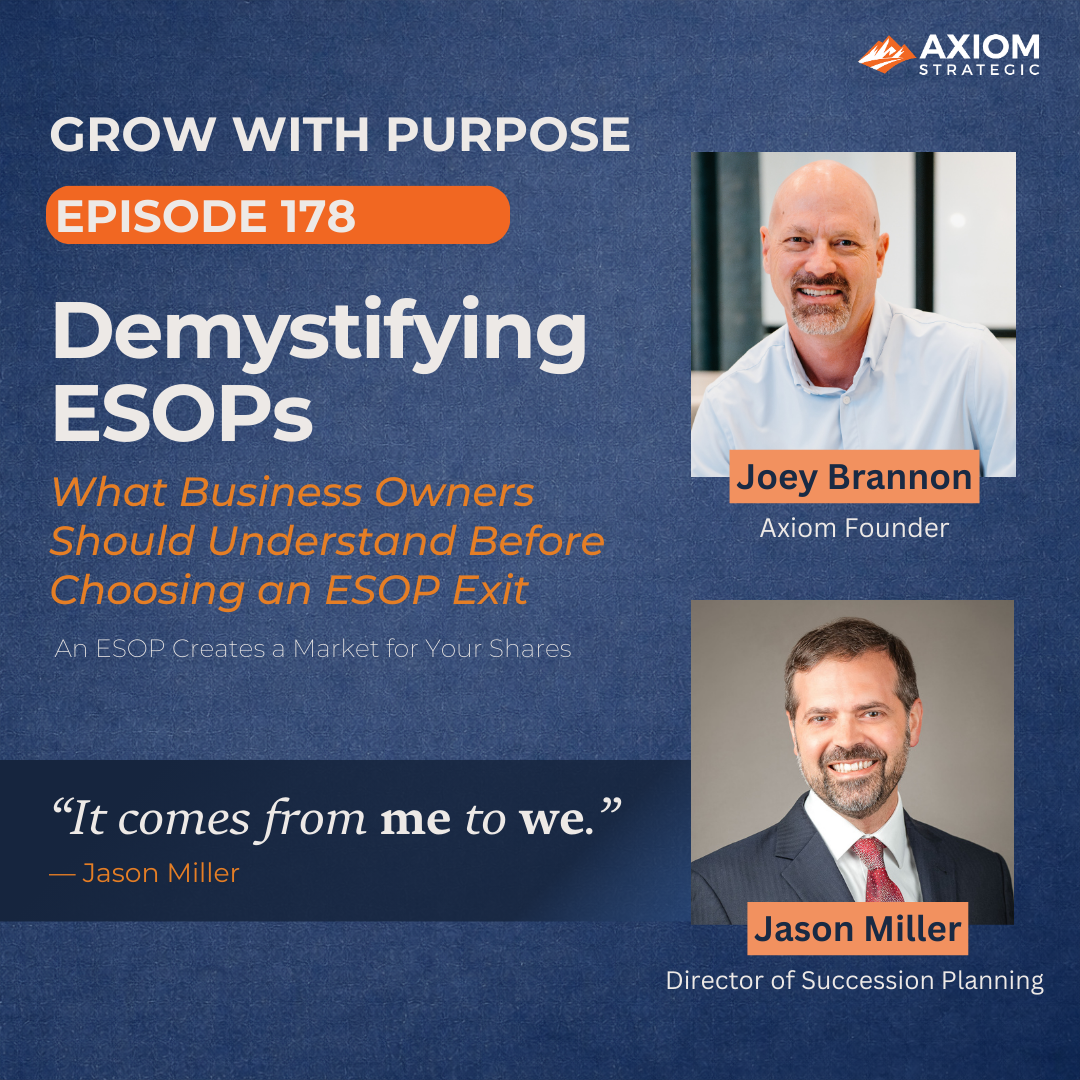
Demystifying ESOPs: What Business Owners Need to Know
When most business owners think about succession, the conversation immediately moves toward private equity, strategic buyers, or family transition. ESOPs rarely enter the discussion first, not because they lack merit, but because they’re misunderstood.
In this episode, I sat down with Jason Miller to unpack what an Employee Stock Ownership Plan actually is, where it fits among the seven primary exit paths, and why some owners choose it even when other options may be more familiar.
This isn’t about persuasion. It’s about expanding the table before making a decision.
Key Takeaways
ESOPs create a structured market for your shares instead of requiring you to find a buyer.
ESOP valuation can differ from private equity because the company typically continues operating as-is.
The negotiation dynamic is driven by fair market value standards, not aggressive return targeting.
Communication determines whether an ESOP thrives or quietly fails.
ESOP transitions often reflect a shift from “me” to “we.”
The Reframe Most Owners Have Never Heard
One of the most clarifying statements Jason made during our conversation fundamentally changes how owners think about ESOPs.
“You’re creating a market for the shares of your privately held company.” — Jason Miller
That sentence reframes the entire concept. Rather than searching for an external buyer and navigating the emotional and operational intensity of a traditional M&A process, the company establishes a trust that becomes the buyer. The transaction still functions as an arm’s-length deal, but the structure alters the dynamic.
For owners who have experienced deal fatigue or the intensity of due diligence, this structural shift can matter.
Why the Negotiation Feels Different
Traditional financial transactions are often driven by maximizing investor return. That reality creates tension, layered motivations, and sometimes deal fatigue.
Jason explained that ESOP transactions operate under a different framework. The trustee representing employees must negotiate toward fair market value under fiduciary standards. That constraint changes the tone of the room.
He described it this way: “The trustee is looking to get a good deal for the employees, but they’re not looking to get a steal.”
That distinction doesn’t eliminate negotiation, but it often removes the adversarial undertone that can characterize financial sales. The conversation is working toward fair market value within a defined framework.
The Tax Advantage Few Owners Fully Understand
Jason was clear that there are significant tax advantages associated with ESOPs, and he admitted his team often gets so deep into the structure and culture side that they forget to lead with it.
He even posed the question this way:
“How would How would you like it if your company never had to pay income tax to the IRS again?”
The key takeaway here is not to assume the details. It’s to recognize this is a real part of the ESOP conversation and worth evaluating with the right experts for your specific situation.
The Valuation Reality Owners Must Understand
It’s important to be direct about something that often goes unspoken: ESOP valuation may differ from what private equity might offer.
In a financial transaction, buyers frequently model operational changes. They may remove departments, reduce advisory costs, or restructure leadership. Those projected efficiencies can increase adjusted EBITDA and drive higher multiples.
Jason also pointed out that a major driver for ESOP attractiveness is continuity. He emphasized that after the transaction there’s no new outside party coming in to tell you what to do operationally, and that “on day two, nothing changes.”
For some owners, any valuation gap is decisive. For others, that gap can be seen as an investment in keeping the name, the culture, and the people intact.
That’s where the philosophical shift emerges.
Who Should Seriously Consider an ESOP?
Not every business is a fit.
But an ESOP deserves early evaluation if:
You care deeply about what happens to your employees after you step away.
Preserving the company’s culture and identity matters to you.
You want continuity, where “on day two, nothing changes.”
You’re open to fair market value within a defined structure rather than a purely return-driven transaction.
You’re willing to give this option “the same level of energy and the same level of diligence… before ruling it out.”
On the other hand, if your primary objective is to maximize valuation for redeployment into your next venture, another path may fit better.
There’s no moral hierarchy here. Only alignment.
From Me to We
At one point in the conversation, Jason summarized the cultural shift required for an ESOP in five simple words:
“It comes from me to we.” — Jason Miller
In my experience, ESOPs often resonate with leaders who have spent years building something bigger than themselves. Leaders who have spent years prioritizing people over ego often find that employee ownership aligns naturally with how they’ve led all along.
The absence of ego is not just a personality trait. It becomes a structural advantage when ownership transitions from one to many.
An ESOP is not merely a liquidity strategy. It is a transfer of stewardship. The founder’s DNA, values, and culture become embedded in an ownership structure designed to extend beyond one individual.
For leaders who have spent decades building something bigger than themselves, this transition often feels aligned with how they’ve led all along.
Where ESOPs Fail
Not every ESOP thrives.
Jason shared a cautionary example of a minority ESOP transaction that eventually reversed course. The structure was sound. The tax advantages were real. But the communication was thin.
Employees received statements. They did not receive context.
He explained the outcome clearly:
“If you’re not communicating… that lack of communication is like lack of attention on a plant, and then it dies.”
An ESOP without intentional education and financial literacy becomes invisible. When ownership isn’t integrated into culture, it doesn’t influence behavior.
Aligning Effort With Long-Term Wealth
At its best, an ESOP creates direct alignment between performance and financial outcome.
Jason described it this way: “It is a direct alignment of incentive for performance and responsibility to a financial benefit.” — Jason Miller
That alignment raises a different question for employees: “What can I do about that?” In other words, if the valuation matters and it’s re-measured, then effort and performance start to feel connected to something bigger than a paycheck.
The mechanism alone doesn’t change behavior. The leadership mindset does.
A Story That Makes It Real
Jason shared an early experience that illustrates the long-term impact of employee ownership. A grocery manager who had spent three decades with Publix came in for retirement planning. He had rarely opened his ESOP statements.
Jason recalled that he “didn’t realize that his 30 years at Publix had made him a millionaire.”
That outcome wasn’t accidental. It was the result of sustained performance, structured ownership, and disciplined execution over time.
Why You Should Evaluate ESOPs Early
The final encouragement from this episode wasn’t advocacy. It was diligence.
Jason urged owners to approach ESOP evaluation with seriousness before dismissing it. As he put it, “Give it the same level of energy and the same level of diligence… before ruling it out.”
Not every company qualifies. Not every owner should pursue it. But every serious succession conversation deserves a full evaluation of available paths.
If your goal is to grow with purpose — even beyond your tenure — then expanding the table is the first step.
References and Downloadable Resources
Podcast —Journey to an ESOP
ESOP Advisory & Succession Planning Firm — Berman Hopkins
LinkedIn — Jason Miller
Episode 178 — Leadership Guide